
Hachette
Review by Walter Cummins
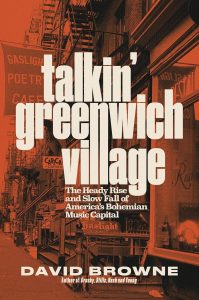
“Slow Fall” suggests that the book is an elegy, but what actually happened to Manhattan’s West Village musical scene is that it took over the country. Despite the area’s shrinking number of performance outlets in the 1970 and 80s, the Village didn’t fall or fail. In many ways it triumphed by spreading its songs and singers throughout the country. An appropriate title for this book could have been “The Square Mile that Transformed American Music.”
Browne’s title alludes to the most well-known of Pete Seeger’s Almanac Singer’s records—Talkin’ Union. But this book could be paired with Tricia Romano’s When the Freaks Came Out to Write, a history of The Village Voice to provide a history of the area in its crucial years. If Browne had chosen “When the Freaks Came Out to Sing and Play,” that too would have been appropriate. In fact, he quotes poet Hugh Romney’s reference to the gaping out-of-towners who “would line up five deep around the block to look at beatniks, an intellectual freak show.”
Although the twisted and tangled street patterns of the Village go back centuries to Colonial streets and earlier cow paths, the contrast with the 1811 grids of most of Manhattan is striking. Where else would West 4th Street intersect with West 11th? Such unpredictable randomness can be considered an appropriate setting for the life styles and artistic output of the influx of artists who came in the 1950s.
Browne, a senior writer for Rolling Stone, has written other books about the Village music world. But Talkin’ Greenwich Village is a comprehensive explanation of all that took place, and Browne, too young to have been there in those decades, writes with a specificity of somewhere who was in the room when the events took place. That’s the result of interviews with literally dozens of people who lived through those times.
Browne focuses on all that happened in the small clubs that became outlets for folk and jazz and the many performers who later became familiar names in millions of households. The most memorable is Bob Dylan, who found his way to the Village in 1961 as a shabby nineteen-year-old seeking a place to sleep and clubs that would let him sing Woody Guthrie songs.
Dylan wasn’t unique. Many others whose early careers included singing and playing in Village outlets achieved real fame. The jazz musicians include the most significant of the twentieth century—Miles Davis, John Coltrane, Thelonious Monk, Charlie Parker, and Sonny Rollins. One club for many was the fifty-seat Café Bohemia on Barrow Street. Others with a bit more space were the Village Vanguard, the Half Note, and the Five Spot.
Mixed among the jazz clubs were those devoted to folk music, such as Gerde’s Folk City. Café Wha, The Village Gate, The Bitter End, and the Gaslight. A number were set up in empty basements, former restaurants, and holes in the wall. But in them people could hear, besides Dylan and Seeger, Joan Baez, the Kingston Trio, Dave van Ronk, Peter Paul and Mary, the New Lost City Ramblers, Leadbelly, Sun House, Harry Belafonte, Joni Mitchell, James Taylor, and on and on. For a number of these artists the pay was minimal, barely enough to cover the rent of a shared apartment.
Now that West Village is a gentrified, very expensive area, many would be surprised to know how many social and political opponents the influx of rebels faced when they arrived. The city created cabaret rules to harass the club owners with picayune regulations about the mixing of music, food, and drink or the number of performers permitted at a single time. Some owners even spent nights on jail. Officials set up legal and physical barriers to guitar players who gathered at the Washington Square Park fountain, leading to large protest gatherings. Another group. local Italian youths whose established neighborhood was being overtaken started fist fights.
City officials were particularly concerned about the people, the freaks, invading the area because they represented a counter culture opposing the country’s values and expectations of proper behavior. The area welcomed mixed races and smoked pot—now sold openly in many states—if not using hard drugs. They mocked middle class living. In addition, the federal government, particularly the FBI, pursued people they accused of communist sympathies.
The decline in Village music dominance began in the mid-sixties and seventies as audience tastes changed to prefer rock. Browne explains: “Then there was the matter of music itself. With the new century came a shift from the vernacular-based genres linked to the Village, like folk and blues, toward genres rooted in rhythm, beats, samples, and tech. It was equally valid music for a different time, but the Village couldn’t keep up or seemed uninterested in doing so.”
Music venues moved to other parts of Manhattan. A good number of the stars went national and even international and gravitated to venues with greater seating capacity that paid more, even much more, as Village clubs with shrinking audiences struggled to stay in business. Browne concludes, “two decades since the Village’s musical heyday had commenced, the past sometimes felt as if it were growing more distant by the month … the legends who had once prowled Village streets with their guitars were also starting to vanish.” While the wide dispersal of Village artists shrank the Village’s prominence in music, the incubation of new music in that square mile resulted in a revitalization of American music that spread from coast to coast.