
Grove
Review by Walter Cummins
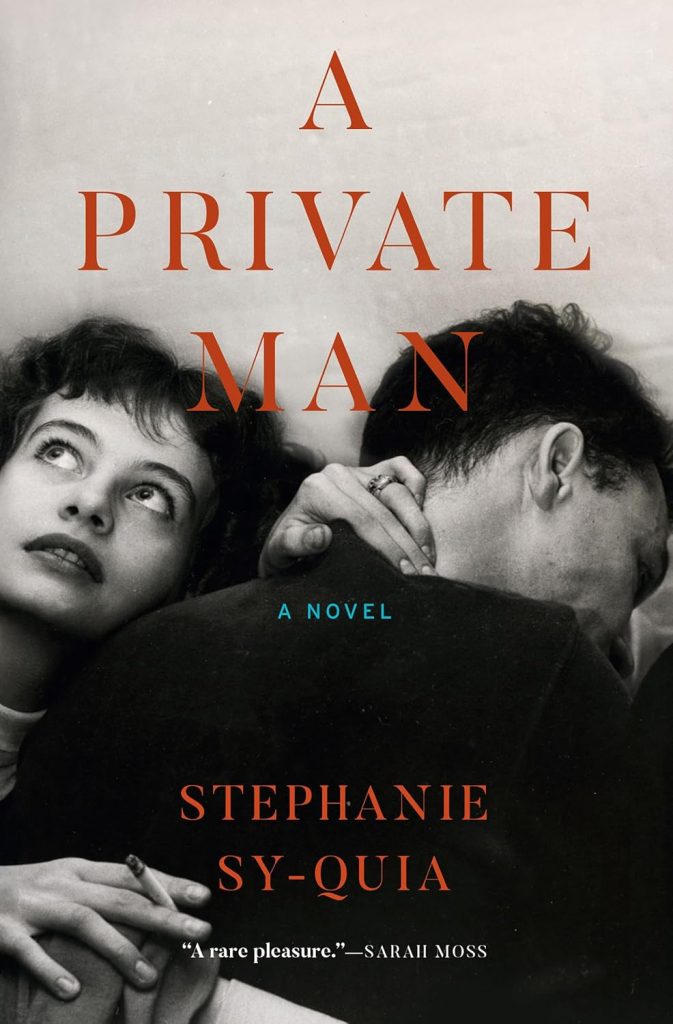
In her author’s note Stephanie Sy-Quia states that the idea for this novel came from an actual family situation—the fact that her grandfather was a Roman Catholic priest. She doesn’t clarify what in A Private Man is biographical and what is invention. It can only be read as a work of fiction, but much of the ambiance does seem historical.
The marriage of the novel’s priest to a lay woman with an extensive theological education was shocking at the time and vibrated through the family and the community for years. Many were upset, even outraged, over the violation of the vows of celibacy, even though the grandfather—David in the novel—had resigned from the priesthood before he married Margaret and they conceived their daughter, too soon in some opinions. Many in their world held David to the commitment of once a priest, always a priest.
Sy-Quia’s dramatization of the steps of the developing relationship conveys their awareness of the gravity of the implications of the decision. The stakes are much more extreme than that of the adulterous loves that result in divorce and disrupt families. David’s commitment was to his god rather than to another human.
David’s Margaret, for all her deep knowledge of Catholicism and her role as a religious teacher, had not taken holy vows and was an experienced woman who spoke out about many positions that violated Church policy, including abortion. She also accepted her sexuality and had engaged in a number of relationships during her studies, some just for the physical pleasure. She can be called a liberated woman who, despite her religious education, was an active rebel against authority. While she understands the pressure David faces, she lacks his barrier to putting love and desire first. In their relationship of priest and teacher she accepts the potential of his initial overtures while he in his innocence is seemingly unaware of their implications .
Beyond their story of romance and marriage that begins in 1953, the novel tells another story, this one taking place decades later, initiated in 2018 and revealed through the perspective of Margaret’s grandson, Adrain. His mother, Hilary, the child of the Margaret-David marriage, lives far away from England in California. Adrain has the responsibility of caring for his failing grandmother, now a very old woman who has fallen twice in Nimes, France, “the beginning of the end.” When his mother gave him that assignment, he first reacted with rage. But when he visits Margaret in a care home, she tells him much about her past, and engages his interest
From what he learns, he understands the difficulties Margaret and David faced, ranging from the family and community reactions, financial circumstances, and David’s disappointing lovemaking. But more pertinent for this second story is what has happened to Margaret at the end of her life. She still shows moments of feistiness and anger. But in many other ways she is played out. What has the drama of the love and marriage considered a violation added up to? A dead husband, an alienated daughter, and a young grandson whose own life pends while he fulfills an obligation to a terminal woman.
The new perspective from three decades after the David-Margaret situation serves as a counter story to that of the romance. In a typical novel the plot questions would be satisfied with the culmination of a marriage and the seeming fulfillment of the love. The implication is a version of happily ever after. In A Private Man what happens next is a troubling exploration of consequences. While the marriage endures until the death of David, it is haunted by the complex difficulties that the union of the wedding failed to overcome. As a couple David and Margaret have entered a different story, one related to the original but involving the need to confront a new set of circumstances.
Beyond David and Margaret, people who did not exist during the time of the romance now have lives tangled by the fact of their origins, inseparable from the tensions of the new story. Hilary, the daughter, has only a distant presence because she lives so far away and finds excuses to delay visits. The burden falls on Adrian, whose obligations to care for his grandmother have denied him the opportunity to create his own life. Margaret, who was once a compelling woman with the power to shape her own destiny, ends up frail and helpless, reduced to occasional verbal protests. This second story pends. It is far from complete but sure to be the source of yet another story that will be permeated with the legacy of the David-Margaret origin.
The novel’s prologue ends with, “His grandfather had been a Catholic priest: a short story in ten words or fewer. And him the living proof.” That information gives away the outcome of the David-Margaret story, the reader aware what will happen—a dramatic irony—with the result is a fundamental uncertainty for the characters. The second story remains open-ended for all. No one knows what will happen next and how the past will complicate the future.