
Harper
Review by Walter Cummins
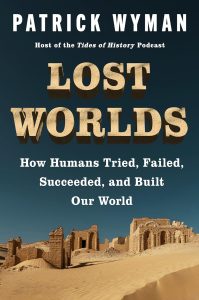
While reading Lost Worlds I discovered an article reporting a prediction in Nature Cities that by 2100 15,000 American cities will suffer a severe loss of population, with some becoming virtual ghost towns. For many of us it’s difficult to imagine high-rise buildings and streets clogged with cars becoming desolate places of weeds growing through cracked pavement and rodents scurrying around abandoned rooms. I wondered if Patrick Wyman’s study of what happened in a very distant past, primarily the 8,000 years of the Neolithic era, would offer clues that explain if our predicted lost worlds would replicate what happened to communities and civilizations in the thousands of years BCE.
Those predicted to become abandoned American cities have only been around for a century or two. Wyman contemplates human habitation in a very different time span, places that existed for, say, one thousand years and left nothing beyond what archeologists unearthed under earthen layers—pottery fragments, stone tools, bones of humans and animals. A few have left a handful of cultural influences, most only little more than the scraps of evidence that they once existed.
One example is Çatalhöyük that functioned for ten centuries 8,500 thousand years ago in what we now call Turkey. Wyman calls it “one of the most remarkable, well-excavated, and extensively studied archaeological sites on the planet.” Thousands of people lived there packed together in something like a city but one that did not function anything like our concept of a city. It was an endpoint in itself and did not leave a legacy for the development of future communities. Eventually, after those one thousand years an accumulation of human and animal waste led to diseases. People just drifted away, leaving only remnants buried in the soil. If recent people drift away from our cities so many centuries later, what will be left, even of towering skyscrapers?
Most people assume a notion that the history of world civilization is a record of continual progress, things getting better and better through stages of habitat advancement, starting with primitive origins and developing as if following a set pattern of improvement, with humans advancing from nomadic hunting and gathering to forms of agriculture that resulted in fixed settlements, eventually civilizations, and on and on.
But Wyman doesn’t see it that way. He considers the evidence from dozens of communities throughout the world where archeological and ethnographic studies have yielded considerable information on how people fed themselves, domesticated animals or hunted them in the wild, built dwellings, and came up with social patterns. He finds there was no universal set of steps for when and how or if tools or pottery were created, when and if crops were planted, how burial practices and forms of spirituality developed, etc. As Wyman sees it:
There was no obvious movement along a linear path from foraging to civilization to the Industrial Revolution and beyond. The individual components of that story did indeed exist. The cumulative impact of all those developments has so fundamentally reshaped our species and our planet that it is difficult to imagine a world without them. We have all essentially ended up in the same place, in a world dominated by cities, states, and intensive food production. But the order in which those developments appeared and the relationship between them is not what we once thought.
However, Wyman concludes, despite specific steps different people in different places took to reach ending up in the same place, versions of three forces are central: the perpetually changing relationship between people and their environment, the reasons for demographic shifts over periods of time, and migration that is usually the result of climate change. He sees climate as the most crucial of the three, the source behind the end of many civilizations and the creation of new ones, ongoing fall and rise.
And in the Neolithic past almost all that rose ultimately had a fall. In some cases, habitations left only empty space; in others, new people and new structures occupied the same places, often with faint knowledge of their predecessors. For Wyman, it’s a mistake to consider ourselves superior to the many generations of humans discussed in this book: “We are them, and they are us. … Our societies are no more destined to survive and thrive than theirs were.”
I now have Wyman’s answer to my question about the likelihood that many of our cities will become ghost towns, replicating patterns seen throughout centuries of human history. If the people of the past are just like us, they probably couldn’t imagine their societies and cities disappearing, their existence lost to the future.