
Dzanc
Review by David Starkey
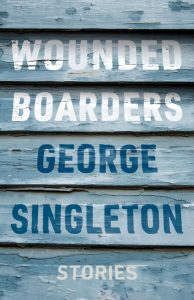
I knew George Singleton for a couple of years back in the early nineties. We were both untenured instructors at a small state university in the Pee Dee region of South Carolina, an especially rural part of that mostly rural state.
I smoked back then, and it was in the smoking area outside the English building where I mostly heard George’s stories. There, or playing quarter-ante poker with some of the other English faculty—if I lost less than ten dollars in a night, I felt I’d done well.
Singleton was always hilarious. People loved to hear him recount his latest drunken exploits, with himself as the endearing anti-hero. He had a mean streak, though. He could be as mean as a snake, or a skunk, or a gator, or whatever critter comes to mind. He loved taking people down a peg, no matter how low they already were, and he seemed to relish that final knife twist at the end of a particularly nasty joke or jibe.
Readers will get a hint of the Singleton I knew in “The,” a story in his new collection, Wounded Boarders. Miller, a once-famous attack comic has come down in the world and now wants to get into woodworking, or possibly restart his career. Miller’s list of bad habits is long, including drinking, smoking, and insulting people who can give him work, so he pays a visit to Sperry Suggs, “hypnotist to the stars,” and soon every time he hears the story’s title word, his bad intentions dissipate immediately. He even goes to church, and when the minister, who has a stutter, gets stuck on the word “the,” Miller collapses on the floor, “shaking uncontrollably.”
Many of the stories in Wounded Boarders have a similar structure, as though they are the punchline to a setup, like, “Did you hear the one about the hypnosis patient whose trigger word was ‘the’?” Or, as in “You’ve Told Me This Joke Before,” the one about the old man with dementia who keeps ordering things online and sending them to his former home. Or the one about the bored young couple who gets their kicks “luring would-be burglars onto the property and shooting off their kneecaps with vintage .22 rifles (“Everyone Said Nothing”). Or the one about the injured combat veterans who play shuffleboard using their prosthetic hooks to slide the puck? They’re not “Wounded Warriors,” they’re “Wounded Boarders.”
However, if making his readers laugh is paramount throughout the book, the stories themselves are much more substantial than fleshed-out jokes. Singleton has a great eye for the telling, and funny detail, and he’s a master of dialogue. “Override” is about a vastly overqualified part-time English instructor teaching Contemporary Southern Literature at the made-up College of the Foothills. Through a series of emails, Emmett Grayson, who could be a stand-in for the story’s author, fends off students who want to enroll in his already full class because he’s preferable to all the boring full-time faculty. “I’m not a ‘Dr.,’ by the way,” Emmett tells one student. “I’m just a lowly adjunct here with a master’s degree and a bunch of books I published. I’m not even sure I’m a ‘professor.’ I rarely profess.” Bitter gruel, as one of our colleagues in the old days used to say.
Another of Singleton’s specialties is a good, long list. Miller in “The,” for instance, is cured by his hypnotist of telling jokes about “men, women, Russians, college students, French people, Southerners, Californians, New Yorkers, Coloradans, the rich, the meek, the poor, fat people, golf enthusiasts….” The list goes on to include another twenty categories of individuals the comedian has belittled.
It’s interesting that nowhere on that list are LGBTQ people, or people of color, and it turns out that in Miller’s comedy, as in Singleton’s book, some topics are off-limits. Donald Trump is never mentioned by name, but whenever an issue of what might be called political correctness arises, our protagonists are always against Confederate flags and racism and right-wing thinking. Indeed, were it not for their localized antics and speech, many of these folks would feel right at home in California. I’m assuming their politics mirror the author’s, and I understand that in a comic story once we stop sympathizing with the narrator, we’re likely to stop reading. Still, the portrayal of Dixie seems somewhat sanitized: it doesn’t quite tally with what I remember, or what voting patterns in the past three presidential elections would suggest.
As with all good comedy, there’s an undercurrent of sadness beneath all the hillbilly hijinks. In “Field Glasses, the narrator, Dwight, is in his hometown of Grimes to pitch a nonprofit environmental project that he knows will probably fail. While there, he learns that the funeral for the mother of his childhood best friend, Clay, will be held that evening and he decides to attend. Clay and Dwight shared, at least in Dwight’s memory, a profound experience when Dwight learned that Clay’s mother had been hospitalized for mental illness. At the funeral, however, and later at the bar, Clay seems to have no memory whatsoever of Dwight. Afterwards, there’s some telephone repartee between Dwight and his wife, but the mood is decidedly somber.
The longest story in the book, “I Know About Childproofing,” is also the most sentimental. The narrator, Renfro Ware, is writing a letter to a daughter, Nancy, who has just learned not only that he is her father, but that the couple she thought were her parents were actually her grandparents. Renfro and Nancy’s mother, Lydia, were college sweethearts; indeed, she has remained his true love for all these years. Lydia became pregnant, but after she died in childbirth, her parents, through some devious legal maneuverings, kept Renfro from ever seeing his daughter or from Nancy knowing of his existence. “I Know About Childproofing” is in some measure a story about class battles among white Southerners, an area Singleton covers throughout Wounded Boarders with nuance and expertise. Still, I think he works best in shorter forms, and I kept hoping the loquacious Renfro would wrap it up.
I’m willing to bet that George Singleton has changed quite a bit since those times way down upon the Pee Dee River (Stephen Foster’s original title for his famous song). I know I have. But his sense of humor is just as sharp, his imagination just as fecund. Wounded Boarders won’t appeal to everyone, but I read it almost straight through, which is about the highest compliment I can pay to any book.