
Scribner Canada
Review by Brian Tanguay
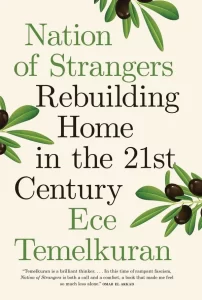
By the reckoning of the acclaimed Turkish writer, Ece Temelkuran, there are many ways to become unhomed. Climate change, war, and rising fascism are among the causes she cites in a Nation of Strangers, but some become unhomed without ever leaving their front door. A noted writer and television host, Temelkuran’s public criticism of Turkiye’s repressive government eventually led to threats against her liberty, and in 2016, she left for good, a decision recounted at the start of the book. Temelkuran has since lived in Tunis, Zagreb and Beirut, and is now based in Berlin. This is her third book in English.
Migrant. Refugee. Exile. What happens to a person’s sense of identity when these descriptions become one’s reality? As Temelkuran observes, whether one arrives by plane with a proper visa, decrepit rubber raft or after walking thousands of miles, he or she will inevitably confront four questions: Who are you? Why did you leave? How will you survive? When will you go home? Nation of Strangers is arranged as a series of letters, each addressed, “Dear Stranger.” Using these four questions as a platform, Temelkuran explores the meaning of home in an age of inhumanity. What can we cling to when dictators rule, institutions fail and cruelty is normalized? How can we remain human when we’ve lost everything and every structure of power seems aligned against us? If Temelkuran’s thesis is correct, millions of people may soon wrestle with these issues, and not only in the “Third World.” Authoritarian political parties are on the rise in Europe and South America as liberal democracies fail to address the needs of the many. Blaming declining living standards on immigrants is a standard tactic of politicians everywhere, and the threat posed by “others” is a time-honored tactic. The idea of becoming unhomed without leaving home is painfully relevant to me, as it captures how I feel about Donald Trump’s America. When I came across this passage — “But what truly severs your ties to a country is to see so many people, ordinary people, supporting the regime even after witnessing its evil — to see so many choosing to be evil,” — I felt I’d found the root and branch.
Authoritarians exploit social divisions and create opposing camps, pitting the “real” people against the “outsiders,” “elites,” or “inferior” people. The leader insists that they alone embody and represent the real people, the deserving people. Before long, as Temelkuran notes, shame is dismantled and loyalty replaces truth and decency; by repetition and spectacle, the leader makes normal what was once considered unthinkable or despicable. Americans are witnessing this phenomenon in real time, though millions seem reluctant to recognize what’s happening. Temelkuran warns that facism arrives when everybody’s eyes are wide open. Some may only be convinced when they personally experience the cruelty and ruthlessness coming from the highest echelons of government. As Temelkuran phrases it, “They do not yet dare to recognise their future country, and soon, they will not be recognised as citizens unless they follow the new rules in Trump’s America.”
Temelkuran writes in a matter-of-fact tone, with moral clarity and power. She knows from experience what it feels like to stand in a slow-moving visa line with other unhomed people, some desperate and down to their last option. Syrians, Ukrainians, Haitians. A sense of community develops in these queues, conversations are carried out in many languages, mutual recognition takes place. Different background, same boat. Ever sensitive to those around her, Temelkuran perceives that what breaks the stranger “is not the exhaustion of becoming unhomed, it is the loss of faith in the home, in the self and others.”
One clear message of this book is that returning to our conventional political home isn’t an option. This is worth pondering. The world may be at a tipping point. But if we can’t go home, where do we go? How do we go about building a reinvigorated political culture, with moral outrage at its core? I don’t fault Temelkuran for not offering a precise prescription. Rather, I applaud her for framing the issue in moral and human terms. To have any hope of success at the scale required, home must be constructed upon “loyalty to fundamental human values,” and include all manner of estranged political actors. The damage already done, and in progress — economic, political, environmental and social — demands nothing less. Temelkuran is telling us something that’s uncomfortable: it’s up to us. Passivity isn’t a strategy. No, it’s on us to use every ounce of agency to reject the structures and solutions that brought us to this point, and insist that reviving a discredited status quo is unacceptable.
Nation of Strangers isn’t entirely pessimistic. In the end, people are the mast, the solid center in the storm to which we must lash ourselves. The longer we refuse to recognize that the antidote to the baleful present lies in the solidarity of strangers, the more we will suffer. Perhaps this notion can only be understood in a crisis, when the humanity of a stranger makes all the difference. Nation of Strangers is a book you will think about long after you finish it. Truth-tellers and prophets shift our perspective, widen our frame of possibility, enlighten the unlearned and trouble the powerful. This is why they’re persecuted and silenced. Fortunately, Ece Temelkuran refuses to be silent. Listen to her.