
Crown
Review by David Starkey
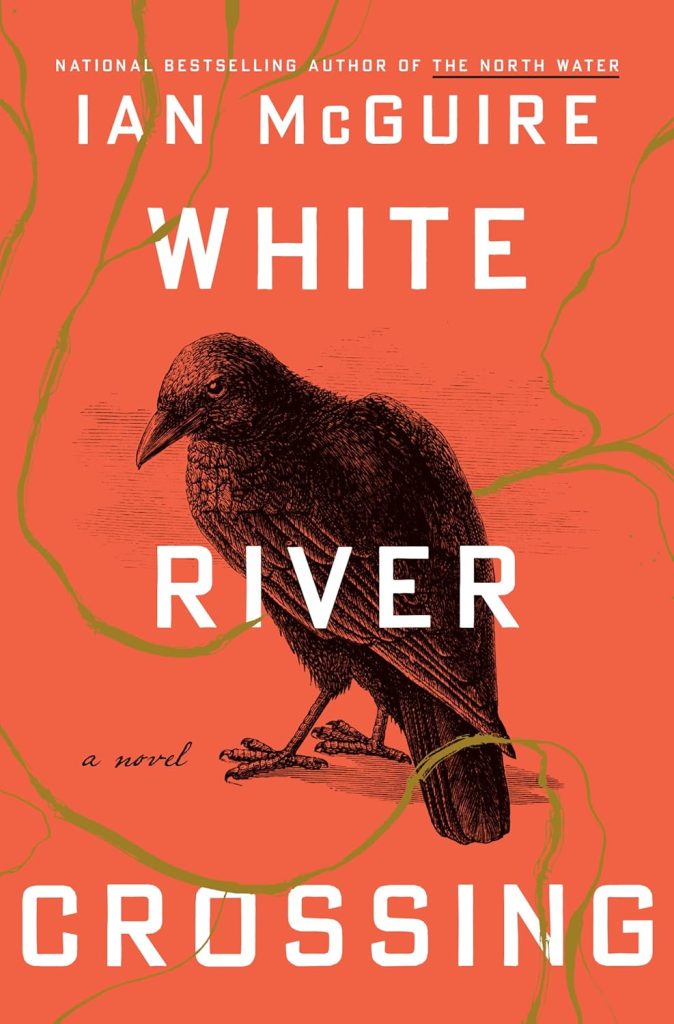
If you were thinking it would be a good idea to send a group of mismatched and underprepared people to Canada’s far north in search of gold during winter, and to do so in 1766, when the land was ruled by, as the narrator of White River Crossing calls them, “Indians” and “Esquimaux,” I must tell you: you were wrong. Indeed, from the moment a “pedlar” walks into the Hudson Bay Company’s fort on the Churchill River and holds out a piece of pale quartz “shot through with a pair of thin and branching lines” of gold,” you can be pretty sure things are not going to go to plan.
However, that doesn’t stop Magnus Norton, the “chief factor” of the fort, from immediately plotting to send a party north beyond the Barren Grounds and across the White River to a distant place called Ox Lake. Leading the party is Norton’s Number Two, John Shaw, a physically powerful and supremely self-confident man. Also along on the quest are Norton’s naïve nephew, Abel Walker; Tom Hearn, a brooding former seminary student turned sailor; and “four Indians…Datsanthi, the captain; his son Nabayah; and their wives, Pawpitch and Keasik.” It may be initially surprising that the women are assigned the hard work of pulling the sleds on which the group’s belongings are stacked, but it quickly becomes obvious that this is a man’s man’s man’s world.
An adventure story like this one relies to some extent on plot surprises, which I won’t disclose, though I will say that jealousy and betrayal abound, and our heroes encounter a number of obstacles on their way to the gold. McGuire’s prose is generally clean and clear, and he has rare gift for evoking all five senses, which helps brings the setting to life. Thankfully, he makes no attempt to try and sound as though he is writing in the eighteenth century. At times, perhaps, there is a distant echo of Cormac McCarthy, though it’s more in McGuire’s doom-laden approach to the battle between true evil and mere human foibles.
Indeed, McGuire’s grounding of the action and adventure in brief philosophical ruminations, particularly Tom Hearn’s evolving sense of right and wrong, is partly what keeps White River Crossing from being just another historical potboiler. You get the sense that McGuire could churn out bestsellers by the dozen if he weren’t so attuned to his well-earned status as a writer of literature rather than pulp fiction.
I was quite taken with McGuire’s previous novel, The North Water, which some critics found overly violent. Wbite River Crossing is comparatively mild, although some readers will surely find the more graphic scenes upsetting. Finally, however, all that matters to me as a reader is whether or not I want to turn to the next page, and that is a test that White River Crossing easily passes.