
William Morrow
Review by Linda Lappin
Crossing from the Oltrarno into the heart of Florence, I always paused to admire the view from the Santa Trinità bridge: a checkerboard of green shutters on yellow walls along the brown river, stark against an azure sky. A naïve American not yet twenty, with a crumpled map in my pocket, I had no idea the bridge where I stood was only about as old as I was. The original dating from the 13th century, had been blown up by the Nazis in the summer of 1944 and rebuilt in the early fifties. As I wandered the quiet halls of the Uffizi Gallery, agape at Botticelli’s Birth of Venus and Primavera, I knew nothing of how these masterpieces had been hidden in a villa near Florence during the war to escape bombing and plunder. Tumbling from a SITA bus into the lush Tuscan countryside on my way to a farmhouse without electricity, I reveled in the rustic adventure, blissfully unaware of the devastation the now nearly abandoned hamlet had suffered at the hands of retreating German troops. The city seemed to have hidden its scars and wounds. Even the Flood of 1966 was a distant memory in the ceaseless pageantry of color, art, joie di vivre that was the Florence of my own primavera.
Only later, after I became part of an Italian family and community, did I begin to hear the stories. Bodies strung up on bridges. A child racing to safety through a minefield before the bombs fell. A young mother hiding with her babies in a neighbor’s attic because her home had been seized by the Germans. An entire village sheltering in ancient Etruscan tunnels underground, surviving on spoiled chestnut flour. Beneath it all: fear, hunger, suspicion, reprisal, grief, and death –things rarely associated with Tuscany today.
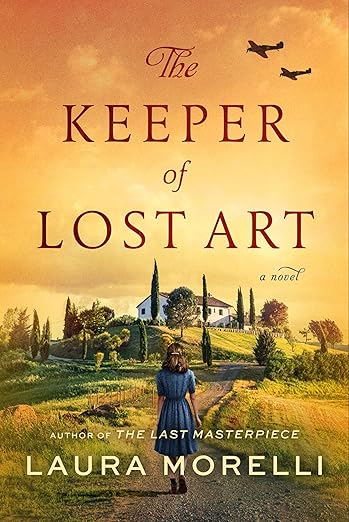
Novelist and art historian, Laura Morelli, (The Last Masterpiece) brings this tormented moment of Italian history to vivid life in her 2025 novel The Keeper of Lost Art. With artful prose and endearing characters, Morelli interweaves two sets of historical events: the evacuation of artworks from museums into the hinterland and the calamitous impact of the Nazi occupation on rural Tuscany, viewed through the eyes of a twelve-year-old girl.
Stella has been sent away from her home in Turin to stay with cousins in the Florentine countryside, where her aunt and uncle serve as caretakers of the aristocratic Villa Santa Lucia whose owner has returned to England. The villa acquires an even more illustrious refugee when the Florentine authorities choose it as a secret repository for treasures from the Uffizi Gallery, among them Primavera, concealed in a locked room at the top of the house.
At first, the villa offers Stella a haven from the nightmare of the Allied air raids that had reduced her Turin neighborhood to rubble. Villa Santa Lucia, with its lavish furnishings and art treasures, possesses an almost fairy-tale atmosphere conducive to dreaming, even as the chaos of war creeps nearer through the wireless. Yet rural life continues as it has for centuries, shaped by the changing seasons and the agricultural chores of the turning year. Homesick for her mother, Stella learns to cope and play her part.
Meanwhile, through those picturesque olive groves and vineyards flows a ceaseless stream of refugees, wounded soldiers, deserters, and partigiani, many desperate for food and shelter. Before long, Stella’s family find themselves housing a legion of the starving and dispossessed in the villa’s cellars.
Among the refugees is an orphan, a boy, Alessandro, whose gift for drawing will open Stella’s eyes to the creative impulse behind every work of art. Together they visit the secret treasure trove to gaze in awe at Botticelli’s Primavera, which celebrates, youth, beauty, spring renewal, and love. Stella is now fourteen; this is her primavera, and as her friendship with the sensitive young artist deepens, she begins to feel the stirrings of her own maturity. Then the German tanks arrive over the hill and the villa is taken over to billet German soldiers.
Skillfully balancing Stella’s inner journey toward womanhood with the upheaval around her, Morelli paints a convincing portrait of life at the villa with unblinking historical accuracy. The author’s concluding note describing her research process is as engaging as the novel itself. The details of the quotidian are fascinating: food and farmwork, housekeeping, boiling linens, burying provisions, treating head lice; the tensions between villagers and refugees; the heroism of the partigiani and the cruel reprisals — summary executions, terror, and the unbearable strain of war itself. Yet despite all, Primavera survives, and the impulse that gave it life prevails.
Readers who relish Frances Mayes’s gorgeous celebration of rural Tuscan life will discover here a more somber note: how blood and terror are trampled into the land of cypresses and olive trees. But they will also encounter the everyday acts of sacrifice, generosity, and courage that have allowed Primavera — and all it represents — to endure into our own times.
Morelli has written a poignant, Disney-worthy tale evoking a catastrophic past, yet subtly reminding us that elsewhere in the world today the struggle to keep our humanity may still be necessary.