
Other Press
Review by Brian Tanguay
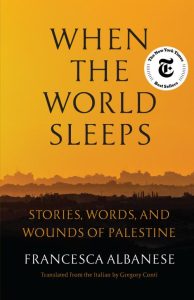
Francesca Albanese is a brave woman, a living example of a public figure who follows her most deeply held convictions wherever they lead, regardless of the personal consequences. While powerful men in suits parse their words, employ euphemisms and deflect responsibility, she speaks directly and forthrightly, naming names and describing reality in all its horror and suffering. An Italian diplomat, Albanese is unique among United Nations officials in that she has been sanctioned by the US Treasury department as a “specially designated national,” not once but twice. For daring to criticize Israel and working with the International Criminal Court, Albanese cannot travel to the US or access financial assets held here. “I have been targeted for reporting on Israel’s violations of Palestinian human rights,” writes Albanese, “or, as the United States chooses to frame it, anti-Semitism.”
What Albanese recounts in When The World Sleeps comes from her own experience living in Jerusalem and via the testimony of ten people, one of whom, Hind Rajab, was only six years old when she was killed by the Israeli army. Malak Mattar is an artist whose family made a harrowing escape from Gaza to Egypt, and felt a tremendous sense of guilt for those they left behind. Through these ten voices, readers gain a sense of the reality of Palestine, and not only after October 7, 2023. The 1948 Nakba, when Palestinians by the hundreds of thousands were dispossessed of their land, homes and livelihoods, is not a distant event. The Nakba’s consequences remain a fact of daily life. The work of Eyal Weizman taught Albanese lessons about vertical politics, a three-dimensional use of physical space employed by Israel to control airspace and subsoil as well as horizontal borders. “The management of infrastructure and mobility, through a system of roads, checkpoints, and separation walls, have been increasingly restricting the freedom of movement of Palestinians in every respect for decades.”
Palestinians have been squeezed, isolated, cut-off from one another. But what upsets Albanese and many others around the world is the indifference and lack of empathy for these long-suffering people. Decades of violence are portrayed in the Western press and diplomatic circles as a conflict between comparable sides, equal powers, when by any objective measure one side is the occupier and the other the occupied. Palestinians can’t structurally subordinate Israelis, control their movement and access to land, air and water or the flow of goods essential to maintain a minimum quality of life. Palestine doesn’t have a standing army, air force or navy supported by infinite largesse from the United States. The one-sided reality isn’t hard to recognize for anyone willing to see, but time and again world leaders avert their gaze, afraid to criticize Israel for fear of being labeled anti-Semitic. Albanese asks, “How can anyone, today, not feel anger or pain in the face of Israel’s actions, at the way it conducts them, and its ability to silence debate everywhere?”
How can a genocide be stopped unless it is seen and acknowledged for what it is? Entire neighborhoods in Gaza have been obliterated, entire families erased from the civil registry, thousands of children have been killed and thousands more orphaned. Gaza is ruble, berms of trash and rivers of raw sewage; the environmental damage alone will take years to remediate. Albanese argues that empathy is the glue that allows us to stand united as humanity, but at the moment the glue isn’t binding the world together. Day after day the destruction and killing continues in Gaza, the West Bank and southern Lebanon, in Syria and now Iran. When The World Sleeps is a forceful and courageous account, often gut-wrenching, and yet Albanese strikes a hopeful note. “Each of us can become a spokesperson and bearer of that hope,” she writes, “learning day after day to adopt it as a posture, a good habit that we can no longer do without.”