
Southern Domestic
Review by George Yatchisin
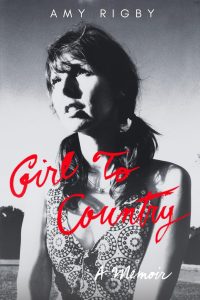
Singer-songwriter Amy Rigby sets up the arc of her moving, charming, outsider-insider’s memoir Girl to Country poignantly in the prologue, when she considers what she might say to explain herself to Hazel Smith, who she calls “the Grande Dame of Music City,” while cheekily describing her “like…one of the Gabor sisters, if they’d been from Kentucky instead of Budapest.”
“I just want to earn a living!” I wanted to shout. “But I also want to be AN ARTIST—to create work that no one else has ever thought of doing. In addition, I’d like L-O-V-E and/or S-E-X, to live in a decent home, and to raise a happy child to adulthood. All while looking cool. That isn’t too much to ask, is it? IS IT?”
When the self-proclaimed Dean of American Rock Critics Robert Christgau reviewed Rigby’s solo debut Diary of a Mod Housewife in 1996, giving the album an A and eventually naming it his second favorite disc of the year, he wrote, “Personalizing the political for a bohemia that coexists oh so neatly with structural underemployment, thinking harder about marriage than a dozen Nashville homilizers,” he had no idea he was predicting Rigby’s next career move. For she would leave the crudy-but-cosy comforts of New York (read all about her exciting exploits there in Rigby’s first memoir, 2019’s Girl to City) for Nashville, hoping her gimlet-eyed, catchy tunes might land her a publishing deal, and therefore steady money.
“I’m no Johnny or June come lately!” is how she tries to sell herself in Music City as a writer with enough living on the odometer to have something to say. By the time she makes the move to Nashville in 1999, she’s 40, well-past ingenue age, a mom, with stints in two groups—The Last Roundup and The Shams—already behind her. Girl to Country is about everything that happens next, at least until 2006. (Perhaps that means we can hope for further memoir installments from this diligent diarist?)
As for Girl to the Country, it’s no surprise Rigby writes with the same nifty knack for homing in on detail that moves her sterling songs (it’s helpful she includes the lyrics of several of them). The memoir is never more affecting than when she recalls the lead up to the creation of what might be her best work, the song “Don’t Ever Change.” Turns out she wrote it post 9/11, after a tour that began in her dear, damaged New York City. Moved by how music seemed such a salve for everyone at the shows, she realizes, “Like many things from that era of my life, I was so fixated on getting somewhere that it was hard to appreciate the beauty of what I had.”
One big part of the beauty in the book is Rigby’s love and nurturing of her daughter Hazel, who prominently figures in “Don’t Ever Change.” The verse about picking the headphones-wearing teen up at school, wanting to smother her with love while trying to act cool, gets to these heartrendingly observed lines:
She had chipped nail polish, writing on her hand

She was nodding her head to her favorite band

Staring into space like she was all alone

But I didn’t take it personal, it meant that I was home
Not just exacting on the page, Rigby’s voice on record (is that still the right term anymore?) always seems direct and personal. Early in the book she laments not being a “Rock vocalist,” going on to claim, “All that came out were my feelings. They weren’t elevated or made majestic by lung power or bravado and technique. Try as I may, I was usually just…a person, singing my songs.” Although she seems rueful about that, I’d argue it’s what makes her so talented—both singing and on the memoir page, she never comes off less than real. And how often do we get that in the world from anyone (even ourselves)?
Girl to Country attests via an accumulation of quotidian detail how hard it is to make it in the music business. Turns out there’s more frustration than glamor for someone critically lauded but never a huge success. The book can read like a running, or should I say not-running, gag about trying to find good wheels, a major hassle both for a musician who needs a vehicle to get herself from gig to gig (moments on other, bigger artists’ tour busses seem like a dream of luxury) and a way to get her daughter to and from school.
Alas the book also explores the harrowing price one might have to pay to land the best wheels, a silver BMW. For an excruciating too-long stretch Rigby is involved with the well-off but manipulative and domineering Charles, who gifted her that fine ride. Fittingly it’s an epiphanic moment of music that firms her resolve to dump him despite the financial comforts that he offered, including a working laptop with Pro Tools and recording software. He brings her to a Bruce Springsteen solo show, on the tour when the Boss surprisingly took to covering Suicide’s “Dream Baby Dream,” which transports her back to simpler if seedier days at CBGB. “How could Charles and I speak the same language?” she writes. And then, “Bruce incantated…. I let the three chords rise and fall and reach inside me like strengthening tonic, thinking, ‘I will end this. I WILL.’”
Fortunately, the book is also a slo-mo romantic comedy. By its end she pairs up with her now husband Eric Goulden, better known as Wreckless Eric, but that takes a years-long build of a cross-Atlantic friendship blooming into romance.
At their first meeting, Eric appears miraculously out of the snow to disc jockey before a Rigby gig in Hull. Rigby has already idolized him for his music, but he becomes more of a fascination, particularly when he kicks off his DJ set with Grease’s “You’re the One that I Want,” playing it cool by being so uncool. Rigby had been covering his best-known tune “Whole Wide World” as part of her set, so she asks him to join her for it, not realizing she played it in a different key. Afterward he tells her, “This song has two chords and both of yours are wrong.”
But that doesn’t mean an attraction wasn’t brewing. At one point Rigby trenchantly describes part of Eric’s allure this way, “He said in his charming voice that sounded like it belonged in a speech bubble on a poster taped to a teenage rebel’s bedroom wall.” After years moving closer despite the time zone challenges, we get to this passage: “But me and Eric playing together felt like being a band, even if it was just the two of us. It was synergy and standing up for each other—a gang of two.” Who better to fall in love with than someone who also has your artistic back?