
Doubleday
Review by Walter Cummins
I first encountered Meghan O’Gieblyn’s writing and thinking in one of her essays for The New York Review of Books. I was used to that publication’s very smart and articulate contributors, but even in that company I found her exceptional. I sought out more of her work in that and other publications, happy to discover new pieces. Eventually, I read and reviewed her second book, God, Human, Animal, Machine: Technology, Metaphor, and the Search for Meaning, even more impressed by her mind and her ability to express her perceptive conclusions.
That’s why this third book took me by surprise, my reaction to a brief description of what Will and Attention was about—the years of alcoholism in her twenties, with a repeat a decade or so later, along with a tangled religious quest. It’s not that someone facing such subjects disturbed me. I know several writers personally and even more by reputation who have willingly exposed their addictions, mental illnesses, family crises, and depression in books and essays, including me. I even published an essay titled “Writing about Our Worst Experiences.” What shocked me about this book is that I had considered O’Gieblyn different from others, unique in her lucidity and wisdom.
But when I read the book I found that even in revealing her greatest traumas, she contemplated them not only from an emotional assessment, but more importantly, one grounded in crucial ideas.
She vividly captures the visceral experiences of seeking belief at a Catholic mass or submitting to alcoholic addiction, the lure of the secret bottle and the satisfactions of being drunk, even the vomiting and the blackouts. But none of these experiences are presented as ends in themselves, as they probably would in a memoir by a fiction writer. For O’Gieblyn, the act and its consequences are examined and interpreted through a connection to a rich philosophical and theological perspective, especially the writings of Simone Weil, along with those of Nietzsche, Schopenhauer, St. Augustine, Iris Murdoch, and many other mystics and thinkers.
It’s almost as if—and perhaps more than almost—her drive to explain life’s happenings through illuminating ideas is another form of addiction, one with a presence throughout the book more compelling than her interludes of alcoholism. Drinking is a reported experience that occurred in the past. Thinking is an ongoing activity, alive on every page. Her insights come through with a fresh immediacy.
One of those insights has to do with her understanding of what it means to go beyond writing this book to exposing it publicly: “The ability to be honest with oneself is no great feat: it costs very little. It’s something else to be honest with others, who might mock you, or disagree with your insights, or abandon the story out of boredom.” For any author driven to turn suffering into words, the reception of those words is an underlying risk, but confessing is an important step in seeking an answer.
Amid this integration of anguish and analysis, her creative and professional achievements enter the book as asides, when in brief sentences she says she wrote some essays, gave some talks, or taught some classes. Out of curiosity, I found her speaking on YouTube assured and articulate, including a recent interview about this book. It’s as if there were two Meghan O’Gieblyns, the creator of the gifted works I admired so much and the woman who was obsessed and addicted, a private, hidden self. She is fully aware of it: it. “I still had magazine assignments and speaking gigs. I had the respect of most people in my life, who remained oblivious to the fact that I’d descended to and resurfaced from the underworld.”
Unlike the many others who have explored the mental and psychological consequences of their worst experiences, O’Gieblyn uses hers to explore philosophical and theological theories about the nature of our reality, where and how our individual lives relate to the universe. Among her most interesting illuminations is her evolving understanding of the nature of God that moves from the dualism of good and evil to the embodiment of all that happens. She brings in William Blake, Hindu scriptures, and other beliefs that the universe’s deity is a totality, especially as described by Simone Weil:
She [Weil] writes that there is, indeed, a realm that exists above the binary of good and evil—though it’s not one of indifference. It is the realm of “absolute good,” the Platonic form of all we call “good” here below, which is merely its shadow. She seemed to believe that humans could experience this transcendent reality through mysticism and spiritual disciplines.
O’Gieblyn notes that the inspiration for this book is a quotation from Simone Weil that contains the two central words for its title—will and attention: “We have to try to cure our faults by attention and not by will.” She knows well that “will,” the conscious effort to reach a goal, is inadequate, but finds the meaning of “attention” much more of a challenge.
One of her attempts to define “attention” is wondering if it “is the way we exercise our desire for truth, and for the good, by teaching ourselves to want it.” Further, her speculation involves a return to a new version of the core beliefs she abandoned in Bible school: “The point of a spiritual life was not to insulate oneself from harm, but to welcome it, in the spirit of amor fati, or loving your fate. It was necessary to love everything, both good and bad, because it is part of the divine order. Christ ‘surrendered himself even to death,’ and we, too, must accept that surrender might lead to our own destruction.”
In its essence Will and Attention is a spiritual quest, a continuation of the one that failed O’Gieblyn in Bible college and drove her into the vacuum that alcoholism failed to fill, but beneath her ongoing everyday she was in a quest for an answer that she sought continually through her deep reading and her quests of writing. Finally, the workings of her mind reveal what she has learned from her grueling experiences.
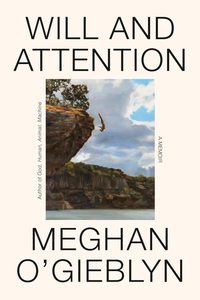
At the end of the book while sunbathing on an Italian beach she watches young people on a cliff take great risks in plunging into depths surrounded by dangerous rocks. She interprets these dangers as existing with the force of gravity. Yet she is struck by a realization that our ability to survive is a form of goodness. She concludes, “Beauty and goodness and order—this was the truly shocking fact of existence. It was not that life was full of rocks and whirlpools; it was the sheer wonder that our vast universe had managed to produce anything but rocks.”