
Doubleday
Review by Walter Cummins
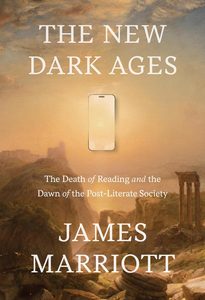
There’s an inherent paradox in what I’m doing here. I read a book about the decline of reading in our time and follow up by a writing a review that I hope you—the surviving cohort of those who are readers—will make one of your choices. And we’re a minority. The great unreading majority will ignore the book and anything I have to say about it.
As thoroughly researched and as informative as this book is—one major pleasure of reading—Marriott’s conclusion based on an analysis of what he has gathered results in a very pessimistic projection. It preaches to the choir of those of us already aware of the shrinking audience for text and the inability of the young to parse a paragraph in the shorter and shorter works they have been assigned. We’ve known that readers are one of the world’s long list of dying species.
But Marriott goes beyond familiar predictions to elaborate on what he believes are the unavoidable social, political, and emotional consequences of our non-reading environment for both the majority who avoid reading and those of us who still read. He concludes that this new reality is not a temporary aberration but a permanent post-literate upheaval. It’s the result of new technology, just as the 18th century reading explosion came about from the rapid rise of literacy and the new printing techniques that made possible the easy accessibility of cheap books, pamphlets, and newspapers. Now the non-literate are absorbed by the universal availability of screens.
There’s no surprise that Marriott puts the blame on screens and their diverting instant gratifications, beginning with the passive lure of television and the much greater dominance of the smartphone. Unlike the TV we leave at home, we are inseparable from the smartphone screens in our purses and pockets, tempted to stare at them dozens of times throughout the day.
For Marriott, reading work in print resulted in one of the most important revolutions in human history: “This was indeed an unprecedented democratisation of information: the greatest transfer of knowledge into the hands of ordinary men and women so far in history. It is a moment in the human story I think we are justified in feeling sentimental about. It was also one of the foundational moments of the modern world”
And now we have the exchange of such knowledge replaced by the unending stream of TikTok’s momentary titillations. Not only do many young people lack the attention span to read a book, they cannot even sit through a movie. Marriott cites one estimation that TikTok watchers can scroll through as much as 260 videos in a half hour: “The ease with which viewers can absorb images and the ease with which images can trigger fierce emotional reactions gives TV executives and TikTok creators great power.” The images they transmit are ineffective for presenting ideas, and viewers become desensitized to the problem solving or deep learning that can result from serious reading.
Functional literacy will survive, access to the data we’ll need to do our jobs and cope with the instructions in our lives, even if those words are AI written. But what is civilization’s cost of existing with the “never-ending distractions” of the new dark ages? Marriott predicts what he calls the “Great Simplification,” with its return to a “mystical, tribal, and autocratic” pre-literate past, will result in an unenlightened future in which “an angry, divided and uninformed public lacks the means to understand, analyse, criticise or change what is going on.”
Marriott’s thesis in The New Dark Ages has resulted in competing reactions, from those who dismiss him as alarmist to those who think he understates the severity of the problem. Personally, I share his fears. But that’s what books are for—to raise questions and stimulate informed discussions.