
Penguin
Review by Walter Cummins
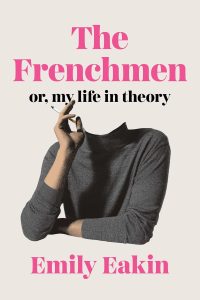
Emily Eakin’s life in theory began in the late 1980s when she was an eighteen-year-old sophomore at Harvard and fell “under the Frenchmen’s spell.” That’s when she first encountered the work of Jacques Derrida and after that the other structuralist and post-structuralist French thinkers. These writings were a challenge for her to comprehend, as they have been for many since then. Having caught the theory bug, she chose the new department called Literature that emphasized theory instead of the more traditional English major. After Harvard, she went to Paris, which already enthralled her, for graduate studies and then to Columbia to work toward a PhD. There, aware of the limited teaching job market for those with English doctorates, she decided to switch to a career in journalism, the final determinant coming when a fellow grad student announced that she didn’t read books, just theory.
Of course, the Frenchmen Eakin writes about in this book also devoted themselves to a life in theory much more deeply, in their case creating it rather than just trying to understand it. As a complication they, despite their academic brilliance, were also at the fringe of normality, from the extreme of institutionalization to deep depression. Murder, S/M, bigamy, family abandonment, and other anti-social behavior affected may in the group.
That raises related questions about the relationship of the creator to the creations. What effects do the behaviors of the theorists have on the validity of the theories themselves? How central are the unusual life styles to the sources of their ideas? Even if they were, does that matter for the value of those ideas?
After all, a central premise of the group was Roland Barthes’ “The Death of the Author,” that divorced the intentions of the creator from the works that resulted, and those works did not have a single fixed meaning but were open to a variety of interpretations depending on the reader. Language creates worlds that are far from fixed or absolute.
Paradoxically, the theorists did not behave according to that principle when reacting to each other’s ideas as expressed in articles, books, and lectures. Even some who had been students of another turned out quick rejoinders meant to undermine the positions of their contemporaries through a counter article, book, or lecture. One of the most crucial was Derrida’s demolishing his former mentor Foucault at a conference at Johns Hopkins. Were such reversals by the opponents in these disputes merely the acts of jealous humans engaged in competitive one-upmanship? Or were they practicing rigorous philosophical analysis?
The ideas dominated. Structuralism and post-structural overwhelmed American university English departments in the 1980s and beyond, leading to an ideological backlash led by those who considered the new ideas threatening. But the crushing blow was ad hominin, centered on the scandal of Paul de Man, the guru of theory at Yale who turned out to be a fraud. His personal failings led many to question whether his or, more significantly, any post-structuralist theories had substance.
The initial attack on de Man resulted from the discovery of antisemitic articles he wrote for a pro-Nazi Belgian newspaper during World War II. Further revelations indicated that he wasn’t actually antisemitic but a poseur acting out any role that would gain him favor. In addition, he was revealed as a financial deceiver and bigamist.
Does that mean his success at Yale and his standing as an influential figure in literary theory were based on another lie and, as a result, made his published analyses suspect? Some academic journals and the popular press considered his downfall fatal to the entire philosophical structure behind him.
For several concluding chapters Eakin gives the impression that she too has turned against theory, completing a turnaround that began when she dropped out of grad school. That’s why for some her Epilogue may come as a surprise. There she argues that, despite de Man and the now minor role of theory in universities, theory has actually triumphed. Our world has been transformed by the messages of French theories. They are ingrained so deeply in our assumptions about the way things are and should be that the great majority who have never heard of Lacan, Barthes, Derrida, and the others have actually accepted their theoretical lead.
Despite the personal shortcomings of the Frenchmen—“mental illness and fears of madness, who struggles with their sexual identities or unrequited love, who committed criminal acts, who harbored shameful pasts”—French theory changed our understanding of the world with insights that are now commonplace: “More broadly, the critique of language elaborated by the Frenchmen from the late 1950s on has led, over time, to widespread acceptance of two radical notions: first, that discourse conditions our experience of reality, […] and second, that meaning is never stable or fixed.”
Ultimately, Eakin’s individual life in theory leads her to conclude that theory has had an impact of all our lives whether we realize it or not. She has resolved the challenge of the ideas that captivated her as a teenager at Harvard.