
Scribner
Walter Cummins
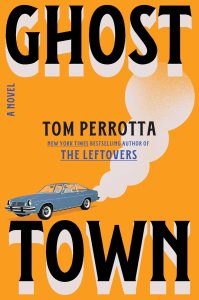
Ghost towns are usually pictured as abandoned places of decaying windowless houses and barren streets. Creamwood, New Jersey, is certainly not own of those, but a busy industrial suburb in the most densely populated state in the country. The ghosts of this town are people and events. Jimmy Perrini/Jay Perry has been haunted by what happened in a place he’s spent decades hoping to abandon. The novel’s opening paragraph reveals his distancing effort, wanting to believe that his childhood happened to “another person in another world.”
Jimmy/Jay eventually faces his demons as the novel comes full circle from those opening words when Jimmy, now Jay—a literary writer and who eventually achieved success with children’s books —returns to Creamwood as a celebrity. At a sparsely attended public meeting his reading begins by repeating opening paragraphs of the novel we’ve just read. These are from the new work is writing decades after the time of those childhood events. For a moment he loses focus, feeling the presence of two ghosts side by one, one he loves and one he despises. But then he ends this novel by envisioning his mother to find his place on the page.
Hints of Jay’s remembering appear throughout when the dominant third-person narrative about Jimmy shifts to first-person commentary from Jay decades after those experiences. The telling of that past has be third-person because Jay wants it to be about the boyhood of someone else. Through the first person, the much older Jay reveals how he became his adult self in hopes of escaping from Jimmy. But deep within he can’t avoid being haunted by all that happened in the town of his youth, shadowy ghost-like memories.
What took place occurred during Jimmy’s summer between his graduation from grammar school and start of high school in Creamwood. To leave it all behind, Jay spent decades living far away in another part of the country, a very different place and a fresh reality. He has not looked back, or so he thinks.
While the town itself serves as a ghost, it’s the totality of many specific ghosts around Jimmy whose unseen presences stay with him. The death of his mother before the start of that summer is clearly the most painful, traumatizing the boy. She had been suffering a painful cancer, Jimmy comforting her often but out playing in a baseball game the evening she had an unexpected fatal cardiac arrest.
He learns of other deaths from an earlier time and even tries to get in touch with his mother though an upsetting Ouija board reading that, instead, leads him to discover someone else, a brutal murderer. At the end of the summer, his father, a volunteer fireman, is killed fighting a blaze in a next door house that may have been arson. Also dead is the cousin of the neighbor whose house it was. Beyond these deaths, Jimmy is disturbed by threating of older teenage boys and a romantic failure with an older girl whose father and brother are dead and her mother a pitiful alcoholic.
The occasion that eventually brings Jay back to Creamwood is the dedication of the town’s new municipal building named for his heroic father, an invitation he first wants to reject, averse to going back and testing his escape. Finally, he submits reluctantly. Once there he discovers a transformation of the architecture and inhabitants that makes Creamwood look like a different place, but he still exists in the force of the past, a past he has now been driven to confront in his writing.
The early chapters of Ghost Town capture the familiar thoughts and activities of a typical thirteen-year-old boy. He plays baseball, hangs out with friends, eats fast food, and has a crush on a girl. Perrotta wants to establish how normal Jimmy was before the shock of his mother’s death threw his life out of joint, leading him into the depths of strange activities—pot smoking, alienated friends, bad associates, and the confusion of being in a world he no longer understands. Perrotta captures Jimmy’s turmoil in prose that does not attempt to sensationalize, allowing his suppressed but anguished emotions to emerge from the actualities portrayed.