
Chicago
Review by David Starkey
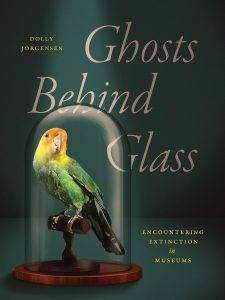
I have to admit that as I was reading through Dolly Jørgensen’s Ghosts Behind Glass: Encountering Extinctions in Museums, I sometimes wondered what, exactly, I was supposed to be feeling. Sorrow for the many extinct species described in the book, certainly, and anger at humanity’s general disregard for most of its fellow creatures on the planet, sure, but what about the museum exhibitions themselves? At the end of a chapter entitled “Cursed Treasures,” Jørgensen, a history professor at the University of Stavanger in Norway and co-editor of the journal Environmental Humanities, writes: “Museums owe it to [extinct species] to tell their stories. To put these treasures on display and face up to the curse. To allow them to haunt our halls. Can telling their stories lift the curse? Maybe not. But it’s all we have.” Honestly, that doesn’t seem like much.
It is really only in the book’s epilogue, when Jørgensen is “weighing the value of displaying extinction,” that she comes out with what seems like a thesis: these displays are similar to those found at the US Holocaust Memorial Museum and the Museum of Memory and Human Rights in Chile. Specifically, they enact three functions identified by sociologist Amy Sodaro: “truth-telling about history and preserving the past; serving as a solemn space of remembrance to help heal and repair; and instilling visitors with a ‘never again’ ethic.”
Those are admirable goals, and perhaps extinction exhibits do work toward them. However, my overall sense of the museums described so carefully by Jørgensen, and illustrated with her vivid color photographs, was the futility of their endeavors. Even if visitors do leave vowing, “Never again,” it’s unclear what they are supposed to do to prevent further extinctions. More to the point, Jørgensen has lavished so much attention on the museums’ examples of extinct species that we can’t help but feel that whatever happens in the future, it’s too late for them.
In London’s Natural History Museum, for instance, Jørgensen has taken a picture of the skin of a thylacine pup, which, as she says, looks “so small and helpless” against the black and white photo of the last adult thylacine in the Hobart Zoo in Tasmania. The British immigrants to Australia exterminated the thylacine, a marsupial also called the Tasmanian tiger, because they incorrectly believed thylacine were killing their sheep, which is horrible enough, but what kind of a lunatic murders a puppy?
Then there’s the 2015 exhibition at the Smithsonian Museum of Natural History, “Once There Were Billions,” about the extinction of the passenger pigeon. In front of a nineteenth-century illustration of hunters blasting pigeons out of the sky are the stuffed remains of Martha, the last of her species, who died in 1914. She’s posed, lifelike on a branch next to another lifelike pigeon with a seed in its beak. In front of this pair, belly-up and without glass eyes, is a third example of the extinct birds. Possibly it’s just me, but when I look at Jørgensen’s photograph of the exhibit, I do not feel a call to action: I only feel despair.
On and on go the descriptions and images of extinction: a Jamaican giant galliswasp upside down in a jar of Formalin in the Hunterian Museum in Glasgow; Nelson the Cape Lion in a glass box in the children’s playroom of the Clifton Park Museum in Rotherham, England; the prenatal fetus of a Sparrman’s quagga in the Naturhistoriska riksmuseet in Stockholm; the tattered remains of an ivory-billed woodpecker at the Muséum national d’Histoire naturelle in Paris. Ghosts behind glass they all are, just as the book’s title indicates, but how are they meant to haunt us? As a lifelong museum-goer I know that, however powerfully I have been affected by an exhibition, once I step out of the museum and back into the sunlight and fresh air, there is some part of me that is happy to leave behind whatever I have just seen. Let’s hope I am the exception.