
Serving House
Review by Walter Cummins
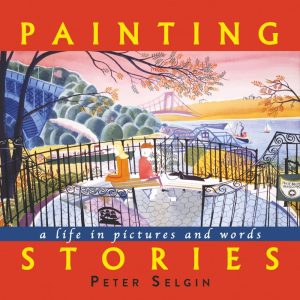
For most of us, having a real ability in two art forms would be considered an enviable gift. But as Peter Selgin reveals, multiple talents can complicate the artist’s life with conflicting stresses in both directions. He details his personal clash in Painting Stories.
Painting Stories is unique. With art on the left pages and commentary on the right, the book offers multiple messages, depending on how you read the title word—“painting.” Is it a verb form or a noun. If a verb, it implies that the works pictured are telling stories as graphic representations of varied narratives. If a noun, the book is a collection of stories about paintings. The book can be considered both, simultaneously.
Selgin explains the situation that led him to create the art works, as well as what the work reveals about technique and medium and about his creative life. In one sense, the book is a developing story, image after image, of Selgin’s artistic career and the tensions between his need to paint and draw and his need to write.
The most vivid example of that tension is found when Selgin reveals how in a studio as an art student at New York’s Pratt Institute, instead of doing the assignment, he chose to write a play at his easel. That upset his instructor and eventually led him to withdraw from Pratt for a period of roaming and discovering. “I spent the next year hitchhiking around the country. I took a notebook with me. I filled it with words. No sketching allowed.”
He didn’t return to art until the mid 80’s when his first novel was rejected. He had been supporting himself with jobs in typography, starting with machines and gravitating to the possibilities of the computer. It was still visual. He considers type an art from, quoting Dürer on the complexities of designing the letter “B.”
For a long period, he did make a living as an artist, using a gift he already possessed as a child when he illustrated homework to impress his teachers. Art came easily. Instead, he had to work hard to shape his potential as a writer. He took years to produce fiction that was accepted for publication, but he soon went on to prize-winning successes with short stories, novels, memoirs, essays, plays, and writing instruction. Painting Stories may be considered one more genre—the autobiographical art book.
While first devoting his time to developing as a writer, he put his art on hold, even placing his art implements in storage. Selgin was facing a real quandary in the desire to balance the call between two artistic gifts: “To draw or write: that’s been my dilemma. When asked, ‘Why don’t you illustrate your own stories?’ in the past my answer would have been ‘Because if they’re any good, my words should make their own picture.’ “ […] “My own soul was divided.”
He believes that creating visual art or writing uses opposite sides of the brain and splits him in two. An example he gives is receiving a call for a commission from the art director of The New Yorker and having to uproot his day. “The brutally swift transition from verbal to visual thinking was a unique form of torture.”
This book’s prose commentaries offer multiple messages, often on the same page. Some are funny, others confessional, others instructive or analytical. For example, Selgin uses the ten years of supporting himself as a caricaturist as an opportunity to give concise lessons on how to create one in just minutes. On other pages, he demonstrates what a Fibonacci spiral is. That’s the mathematical ratio of 1.618034, considered the most perfect of numbers and a “template for harmonious composition.”
Selgin also comments on his own drawing and painting techniques. For example, he loves lines and the ability to angle his pencil to produce a shadow. In many of his works, especially the paintings, the lines are boldly present, along with strong colors, giving the depicted objects a dramatic presence. The preference for lines and dominant colors are also seen in the many book covers he has designed in recent years. It may be that his sensitivity to words gives him an authorial feel for an illustration that conveys an impression of the content within.
Selgin is not the only writer to also produce works of graphic art. Others include Elizabeth Bishop, Henry Miller, Sylvia Plath, Charles Bukowski, and William Burroughs. Some writers have even written about their art works, but Selgin is, so far, probably the only one to make such commentary a complete book that for many pages displays both his visual and verbal talents. The fact that he could produce this book suggests that he has come to terms with his demanding gifts by combining them under one cover.