
Harper
Walter Cummins
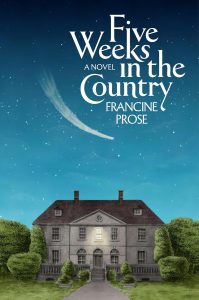
Readers can fantasize the meeting of two literary titans as an opportunity for an exchange of legendary brilliance. But it doesn’t always work out that way. When James Joyce and Marcel Proust met in 1922 at a Parisian dinner party, it was a dud. They had little two say to each other, neither having read the other’s work . Hans Christian Andersen worshipped Dickens’ writing, though Dickens had only scant knowledge of Andersen’s. But they had the opportunity of many days to share wisdom. It didn’t work out that way, as Francine Prose recreates what may have happened during Andersen’s five weeks at Dickens’ country house, Gad’s Hill.
The fact that Andersen overstayed his visit sounds like the stuff of comedy, the guest who would not leave, failing to take hints that he should be gone. But Prose, mixing known information with imagined exchanges and incidents, find little to laugh at, even moments that could be funny, like an exhausted Andersen dropping onto a carpet for deep sleep moments after he entered Dickens’ home. It might be funny for a moment, but sadness pervades her telling, unhappy people thrust together for an insufferable period at a low point in their lives.
Coincidentally, I learned of the visit around twenty years before Prose’s book. The exchange was unplanned and spontaneous. It happened that I was at a dinner table with Ruth Padel, a British poet writer and BBC broadcaster, Sebastian Barry, an Irish novelist and playwright, and Thomas E. Kennedy, an American writer who had lived in Copenhagen for decades. I don’t recall but assume it was Tom who brought up the Andersen visit because he knew so much about Danish writers.
Padel and Barry, to their surprise, had both been working on the subject, she for a BBC4 series on Andersen that had already been aired, Barry for a play that he was still trying to get in shape. A version titled Andersen’s English did have a production a few years later, in 2010. Reviews were mixed. Critics “felt it didn’t fully deliver on the promise of its extraordinary premise.” Prose does make much of the difficulties that resulted from Andersen’s halting command of English, along with his confused understanding of English social conventions.
While by far I was the least knowledgeable of my dinner companions, I had taken a Dickens seminar in grad school and had been moved by Andersen’s Little Mermaid. I also had visited the Dicken Museum in his former home on Doughty Street in Bloomsbury, where Dickens lived shortly after his marriage to Catherine. Since then, I have learned much more about Dickens’ biography and Andersen’s maladjustments as a man. That allowed me to supplement Prose’s presentation with the equivalent of mental footnotes. As a result I can’t imagine how a reader who knew little about the people involved would react to the book. But I hope Prose’s presentation would be equally engaging for someone reading the book as a complete fiction.
Unlike the Joyce-Proust failure, Prose does include the actual successful Dickens-Andersen evening ten years before the country visit. They got along quite well at a dinner party, Andersen new to English readers but considering Dickens “the greatest writer of our time.” The meeting followed up with an exchange of letters.
Prose includes this dinner discussion in the second section of her book, one told from the perspective of Dickens. The other sections retell what happened from the perceptions and knowledge from other participants, the first from the collective viewpoint of the nine Dickens children and the third from that of Andersen. The last two parts are a few imagined letters, and Prose’s recreation of “The Tears of the Comet” that is very different from Andersen’s actual tale, hers integrating information from the visit.
Andersen’s immediately unwelcome arrival came at one of the unhappiest times for the. Dickens family, particularly in the midst of Dickens’ route to a legal separation from Catherine that would deny her her children, those nine children—ages twenty to five—aware of the parental conflict and longing for the affection of their detached father, Catherine weeping in her bed, Dickens disappointed because his childhood dream of living in the house Gad’s Hill in Kent had not brought happiness, and more so because of the tension of his nastiness toward Catherine. He avoided Andersen, angered when the man cut his gladiolas and sat in his garden chair. He had assigned his eldest child, son Charley, to shepherd Andersen around London, a task Charley resented.
Andersen craved Dickens’ affection, saddened that he was being ignored. But such rejection was typical of Andersen’s life, particularly his sexual failures. He never had a sexual relationship but kept a coded count of his many incidents of masturbation. Mockery continued after his death. I once received a photo on his life-sized statue in Copenhagen with a naked woman on his lap. Prose doesn’t include the masturbation, only his longings.
During the weeks of his visit, Dickens began his relationship with Ellen Ternan, whom he first encountered when she had a minor role in a performance of The Frozen Deep, a play he wrote with Wilkie Collins. She was eighteen, he forty-five. Biographers debate the nature of that relationship, some arguing that it was never consummated, others that it produced a stillborn son. Here too Prose just stays with the first weeks of that relationship.
Prose does have invented scenes in which a tearful Catherine confesses her unhappiness to Andersen, including her suspicions about Ellen Ternan. Charley, who had had little to say to Andersen, now confesses his upset at encountering his father and Ellen when walking in a park.
Has Prose, unlike the critical complaints about the Barry play, delivered on the promise of her story’s premise? I believe so. The story of the potentially comic visit, has turned out to be a sad affair, and would be even if the principals had not been two famous writers.