
Verso
Review by Brian Tanguay
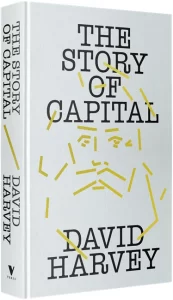
David Harvey has been writing about, interpreting and teaching Karl Marx for decades. In The Story of Capital he ambitiously attempts to explain Marx’s key ideas for general readers. This is by no means an easy task, not only because some of Marx’s ideas are complex, but also because Marxism is something of a fixed notion, especially in the United States, either vilified, employed as an epithet or dismissed out of hand as irrelevant to contemporary times. Rarely is the intellectual framework of Marxism given a fair hearing in mainstream discussions. In the United States the belief that capitalism is the only way to organize the economy and society is practically immune from challenge. Capitalism is equated with freedom and democracy, Marxism with totalitarianism and central state control.
There’s plenty of theory here and truthfully some of it makes for ponderous reading, but overall Harvey is an excellent guide who excels when he shows how theory plays out in society. Most people don’t spend much time thinking about macroeconomic theories as they live their workaday lives until there comes a shock to the system, like the mortgage meltdown of 2008 or the Covid pandemic in 2020. It’s in times of crisis that the underlying architecture becomes more visible. Surprisingly, it has taken decades for Americans to fully grasp just how unequal our society has become, but even with more widespread recognition that something is wildly out of whack, agreeing on the root causes seems to produce polarization and alienation rather than solidarity and demands for change. The public isn’t encouraged to blame monopolies or billionaires, rather it’s illegal immigrants, diversity initiatives and woke universities who are targets of public ire.
What is capital, anyway? Is money capital? Yes, but only when it circulates in a particular way. Money becomes capital in its interaction with labor and materials, equipment and machinery, and in the distribution of wages and profits. Banks facilitate the process by making loans. The state plays a role through the assessment and collection of taxes and regulation. As Harvey explains, the process of circulation is distinct and at least in theory it repeats. But capital is plagued by contradictions and doesn’t always follow the script or behave rationally. “The sight of unemployed capital and unemployed workers,” Harvey writes, “side by side in the midst of obvious chronic social needs makes no sense. It is stark testimony to the fundamental irrationality of capital.” A key idea is that Marx correctly identified capital’s laws of motion in the nineteenth century, and how its dynamism is susceptible to myriad interdependent forces.
Defenders of capitalism often claim that rough-and-tumble free competition keeps the system honest, separates viable enterprises from failed ones, but in practice capitalists prefer, and use their resources and influence to secure, the “quiet privilege of rentierism” rather than engaging in production. Marx presciently theorized that under-regulated capital would result in the sort of monopoly control and heightened concentrations of wealth seen today. Harvey points out that “Since 1980, political power has sought the neoliberal holy grail of lower taxes for the rich while limiting its liabilities to provide for the population at large.” Avoiding taxes has spurred the creation of a wealth protection industry; the global super wealthy have battalions of tax attorneys, accountants and offshore tax havens to shield their wealth from tax authorities.
Uneven geographical development, technology and capital mobility have produced vast pools of disposable surplus labor around the world. The deployment of AI and climate change threaten to fuel this problem and unleash greater numbers of people searching for a sustainable life. Left to itself, Harvey argues, capital will inevitably destroy the primary sources of its own wealth: people and the environment. This phenomenon is playing out in real time, and thus far the ruling political and economic castes have responded by taking a rightward turn, erecting barriers to migration while taking few concrete actions to mitigate climate catastrophe. Voluntary, rather than binding, efforts remain the order of the day as is seen at every meeting of the Conference of the Parties (COP). Year after year, the climate can gets booted down the road.
That there’s not much in the way of encouragement in The Story of Capital isn’t surprising. I wouldn’t expect a Marxist scholar to offer suggestions to remediate capital’s contradictions or blunt its serrated edges. We may be far beyond such bandaids. Harvey identifies three primary conditions that threaten the future of endless capital accumulation. The first is the malaise and alienation at the bottom of the wealth pyramid and the social ills this produces. Donald Trump gained political power by exploiting economic and social grievances. The second is the staggering concentration of wealth and political power in what is now recognized as the Billionaire Class. This class of plutocrats controls more wealth than some nations, and it keeps the value of assets in which it’s heavily invested high. If the adage that what goes up must come down is true, will we at some point face the prospect of asset deflation and financial collapse? And then what? The third condition is climate change with its threats of fires, floods, droughts, pestilence and pandemics that drive economic precarity and mass migrations.
Some signs suggest that American economic hegemony is beginning to crack. The global order that has allowed America to dominate for eighty years is fraying, alliances are shifting and the dollar may not be the first-choice reserve currency for long. The decline of the key capitalist economy in the world presents uncertainties and perils, but it also creates opportunities for restructuring on a more humane and sustainable basis. What Marx offers, and why his work remains relevant, is a framework for critique and analysis. Harvey believes that we desperately need an optimism of the intellect to jump start an optimism of our will. How else is social change brought about?
It’s also hopeful to remember that capitalism was created by human actors, not bestowed on us by gods.