
Bloomsbury
Review by Brian Tanguay
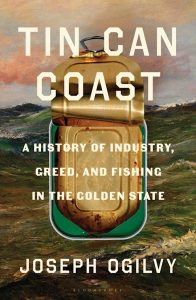
What do sea otters, abalone and sardines have to do with the settling and development of California? What can these creatures reveal about the age-old struggle between greed and conservation? The answer, as Joseph Ogilvy illustrates, is that the making of the Golden State is intimately tied to the California Current, 1,900 miles of the most bountiful and productive waters on earth. The products of these waters sustained indigenous people for millennia, drew Spanish colonialists, Russian and American fur traders, Chinese abalone farmers, and Japanese fishermen; the current made the fish canning industry in Monterey and the San Diego fishing fleet possible, while competition for the riches of these waters sparked virulent racism and cut-throat capitalist behavior.
Ogilvy brings the varied strands of this history together. As a native Californian living within sight of the Channel Islands and less than a mile from what was Santa Barbara’s China Town, I learned details about the past I was only vaguely aware of previously; the historical marker on Canon Perdido Street that I’ve walked past hundreds of times is more meaningful now.
In the 19th century the abundance of the west was awe-inspiring and seemingly infinite. Gold miners pitchforked salmon from Sierra mountain streams and abalone grew to the size of frisbees, while sardine schools were as big as tour buses. Before Europeans arrived in significant numbers, the Chumash had learned that a balance needed to be struck; when abalone stocks declined, the Chumash incorporated sardines and other finfish into their diets and allowed the abalone to recover. The Chumash saw the consequences of their actions, the risks of taking too much. Not so the Europeans and later the Americans, who, it’s worth remembering, slaughtered millions of buffalo as they subdued the west. Sea otters met the same fate because their waterproof pelts were coveted and fetched a high price from Chinese buyers. Why take a few when taking them all produced a fortune? A similar dynamic played out with abalone, sardines and tuna. Twenty-six new canneries opened in Monterey ahead of the fishing season in 1918; by the 1970s, only a half dozen canneries still operated in the entire state.
On man-made Terminal Island near Long Beach in the early 20th century there existed a large Japanese fishing community. Men fished, women processed the catch, kids went to school. The community was self-contained and yet a point of contention because the Japanese were able competitors, skilled and productive and therefore a threat. Industry rivals and the state itself tried many times to ice the Japanese out, but Pearl Harbor would succeed where they failed. After the Japanese attack, most of the population of Terminal Island was rounded up and interned, and when they returned to the village a few years later their boats, tools, homes and possessions had either been sold or demolished.
While Tin Can Coast deals with exploitation and greed, cooler heads attempted to establish limits over the years. The state Fish and Game Commission did its best, but was hampered by a lack of scientific information. Technology for estimating fish stocks was limited and enforcing limits was not only difficult but politically unpopular. Huge investments in plant and equipment had been made, livelihoods depended on an ever larger haul, business-interests had clout and they insisted on riding the boom until it went bust. We know this story all too well.
Greed, myopia, indifference. As Ogilvy notes in the Epilogue, the California Current is at risk of becoming a mere attraction, “treated like an icon in a museum.” Today, the abalone are conceived in hatcheries, the sardines in tanks, and the tuna reside in the holds of charter boats.