
Eastover
Review by Walter Cummins
I met Jay Neugeboren at the book launch for a mutual friend after knowing about his writing for years. We shook hands and had a brief exchange, me telling him that when I used a literary magazine in a contemporary fiction course, my students voted for his story as their favorite in the issue. He was pleased. I never saw him again, missing the opportunity to know much more about him. But now that I’ve read the essays in Dickens in Brooklyn, I’ve caught up on what I might have learned in subsequent conversations, and I’m glad that I have. Now I’m familiar with his reading, his writing, and his family, the good and the bad. His life is worth knowing.
This collection covers the range of his many experiences and of those around him—what it was like to grow up in a 700-square foot flat with parents who constantly argued, how his younger brother had several mental breakdowns, and how he developed a close relationship with a holocaust-survivor cousin who told him what it was like to be a young girl assigned to collecting bodies in a concentration camp.
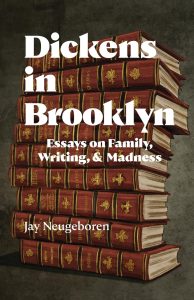
The title and opening essay in the collection, “Dickens in Brooklyn,” establishes several themes that run through the collection. Neugeboren’s parents clipped newspaper coupons to send in to begin receiving compact volumes of the complete works that were displayed prominently in a living room cabinet. From childhood, the aura of literature played a prominent role in his life. He wrote his first novel at age eight. Later he was able to see Dickensian parallels in the dynamics of his family’s tensions. The relatives engaged in a battle over the inheritance of a house he compares with the never-ending court case of Jarndyce vs, Jarndyce in Bleak House, “the family curse.”
Beginning in adolescence, time to write became crucial to Neugeboren, dominating his thinking and even significant life decisions. When a young girlfriend was planning a marriage with children in a suburban setting, he bolted from what that would do to his opportunities to write. In his twenties when winning praise as a management trainee for Chevrolet, he resigned, again fearing what that career would take away from his writing.
The young Neugeboren turned out stories and novel after novel, all rejected for years. One day he even covered his apartment wall with thousands of rejection slips but changed his mind, leaving only a quotation from George Gissing that a writer has no basis to be angry at rejection: “Who asked him to publish?” Ultimately, publishers did begin to ask Neugeboren for his work, totaling more than twenty volumes of novels, story collections, and nonfiction,
This collection is one more. Of the essays, first published in magazines, many have some connection to writing and Neugeboren’s relationship to the literary world and the people in it. Late in her life he found and formed a caring friendship with an isolated and lonely Martha Foley, who for more than thirty years annually selected and edited The Best American Stories and with her deceased husband, Whit Burnett, created the significant STORY magazine. He even imagines a deep literary conversation with his close friend Oliver Sachs shortly after Sachs’ death.
One of the most complex and interesting pieces in the collection is “What Happened to Frankie King?” that also became a graphic novel Neugeboren created with his artist son Eli. He learned about King, considered a great basketball player by many who saw him, from the husband of a writer friend who shared the time of Neugeborn’s youth in Brooklyn. Voted all-city at fifteen, King was coveted by many colleges. He chose the University of North Carolina but dropped out before playing a game. In the army he committed an offense that led to a year in prison. After release and back in the city, he published more than thirty novels, five under his own name, the rest mostly cozy mysteries under a female pseudonym.
Neugeborn went on a search for the fate of King, seeking out friends and family, comparing King’s potential with the many talented Brooklynites who went on to fame. That becomes the essay’s real subject, eventually comparing King and what turned up to be his mental issues with those of Neugeborn’s brother, Robert, recognized in his teens for many exceptional talents before his first breakdown at nineteen. Considering both men, Neugeborn cites what Edmund Wilson said about Philoctetes and Sophocles’ other tragic heroes: “those insane or obsessed people … all display a perverse kind of nobility.”
That essay, like a number of others, becomes a consideration of the place of people with such problems in society. In the book’s final essay, “Cousins,” Neugeborn reviews the lives of many in his extended family, those that went on to success and those who failed because of mental and emotional problems. He ever reveals his own periods of doubts and depressions, even brief thoughts of suicide. Of course, he overcame and led a successful life as he fulfilled his childhood dream of becoming an author,
These essays reveal a very perceptive and sensitive human being who clearly cared for others, devoting much of his to them, including the needy Martha Foley and his mentally ill younger brother, writing a book about him. Even after decades he had a friendly meeting with the woman who wanted the suburban family that he turned down. In these essays he gives all that happened to him a meaningful immediacy.