
Osprey
Review by Brian Tanguay
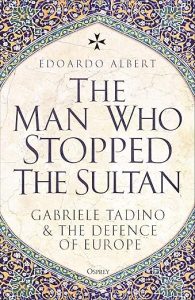
Unless you happen to be a historian of the 15th and 16th centuries, or extraordinarily well-read about that time period, I’d bet you’ve never heard of Gabriele Tadino, an Italian who made himself one of the preeminent military engineers of his time. Until I read Edoardo Albert’s dynamic account, I’d never heard of Tadino or given much thought to how wars were waged during that time, and even less to the warring parties, which were numerous and constantly changing. Albert illustrates how Tadino straddled the medieval and the modern, the last campaigns of the Christian knights and the emergence of professional soldiers, progressing from the age of arrows, swords and armor to the advent of cannons and rifles.
“From 1494 onwards,” writes Albert, “warfare in Europe became the conflicts of the newly consolidating and still quite fluid nation states. Only nations could raise the funds necessary to fight the new wars. Only nations could afford to fight such wars and the wars themselves became broader, eventually spreading to become the pan-European conflicts characteristic of the next few centuries.” Gabriele Tadino participated in most of the consequential battles of this era. He fought at the battles of Agnadello, Ravenna and Pavia, and was present during the sieges of Padua and Brescia. But it was the Ottoman siege of Rhodes where Tadino employed all his experience and skill. Rhodes was the fortified bastion of the Knights Hospitaller and a prized target of the Ottoman sultan, Suleiman. By the customs of the day, Tadino shouldn’t have been at Rhodes because he was bound to the nation-state of Venice. It was Tadino’s deep and genuine Christian faith that compelled him to defy his Venetian employers and join the Knights on Rhodes; he would pay a steep price for this disobedience.
Without Tadino’s expertise in fortifications and tactics, the Knights might have been wiped out by Suleiman’s overwhelming forces. Instead the Knights managed to escape Rhodes and reconstitute their order elsewhere. The siege was costly for Tadino as he lost his right eye to a gun shot, the most severe of all the injuries he sustained in his long military career. Unable to return to Venice, Tadino became a military advisor to Charles V, the ruler of Spain, traveling widely to inspect and improve the defenses of Spanish outposts. Meanwhile, martial culture was rapidly changing. The invention and steady improvement in gunpowder weapons not only changed warfare, it changed social relations, leveling them out. As Albert writes, “a commoner with an arquebus could kill a prince of the blood, and there was no suit of armour or training that would protect the prince against such an ignominious end.”
For a work about ancient history, this is a remarkably accessible and engaging book, written with a novelist’s eye for telling detail. The chronology, maps and illustrations enhance the story. Gabriele Tadino embodied the spirit of a Knight, willing to sacrifice his life for God, but by the time he died in June 1543, he had become a modern man. Tadino was buried in a marble tomb inside a church, but the tomb was lost when the church was later remodeled. Fortunately, Edoardo Albert brings Tadino back to life.