
University of North Carolina Press
Review by Brian Tanguay
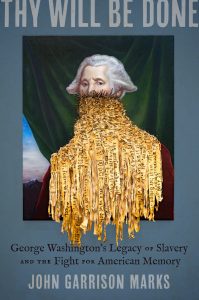
The legend of George Washington is deeply etched into the American historical consciousness. The Virginia native is revered as the father of America’s democratic republic, the boy who couldn’t tell a lie, the brave hero of the French and Indian War, general of the victorious Continental Army, and the nation’s first president, a role he walked away from, establishing the peaceful transfer of power as a bedrock political tradition. America’s capitol city is named in his honor, as are streets, boulevards, bridges and schools across the country; his final resting place, Mount Vernon, is one of the most visited historical sites in the country. Washington has been our touchstone, portrayed as the human embodiment of America’s highest ideals.
And yet the title by which Washington was known for most of his life was “Master.” For more than fifty years, Washington owned slaves, rented slaves, bought and sold slaves, and profited from slave labor. Six months before his death in 1799, there were 316 enslaved people at Mount Vernon — 197 adults and 119 children; 123 of these people belonged to Washington, his wife owned 153 people and 40 were rented from other enslavers. Washington’s last will and testament stipulated that his slaves be manumitted upon his death. That document took on significant importance, setting in motion one of the largest private emancipations in American history, and also providing proof of Washington’s abolitionist convictions. The will was published, shared, studied and cited by abolitionists of every persuasion, from those agitating for immediate emancipation of all enslaved people to those favoring a gradual approach.
In Thy Will Be Done, historian John Garrison Marks explores George Washington’s long relationship with the institution of slavery, and how history has regarded the role slavery played in Washington’s life and public career. Marks provides context and explains how perceptions of Washington have changed over time, and how various actors have parsed Washington’s legacy to support their own ideological assumptions. What emerges is precisely what one should expect from a careful examination of the facts about the life of a historical figure: a complex, nuanced and often ambiguous portrait. Marks goes even further by investigating what became of the enslaved people Washington emancipated, an inquiry almost completely ignored by historians and one hampered by a dearth of primary sources. Some of the emancipated people remained at Mount Vernon, the only home they’d ever known.
During the 19th century abolitionists like William Lloyd Garrison reminded audiences that Washington was an enslaver, guilty of hypocrisy. “Shall he be ranked among the friends of liberty,” said Garrison, “who chains, enslaves and crushes a portion of the human race?” During the 1932 Washington Bicentennial, Black scholars such as W. E. B. Du Bois used the occasion to advance their own agenda by placing Black history at the center of the story rather than the periphery. This effort represented, as Marks notes, “a profound protest against the exclusion of African American history from official histories and school curricula.” In the book’s penultimate chapter, Marks examines how Washington and slavery has been portrayed in American classrooms, a subject that remains controversial and contested to the present day.
The final chapter looks at the role Mount Vernon has played in interpreting Washington’s involvement with slavery, and how the site mirrors a broader and enduring struggle to make sense of Washington’s life and legacy. No easy answers emerge, but Marks argues that attempting to grapple with complex historical issues is worth the effort. George Washington, he notes, has served as a “convenient and flexible symbol to be manipulated or as a weapon to be wielded in ideological battles that stretch back more than two centuries.” When Washington is presented in all his dimensions the result can cause discomfort for some and feelings of ambiguity for others, proving, if nothing else, that burnished myths take a long time to fade.