
Anansi
Review by Brian Tanguay
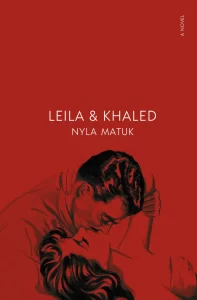
Leila, a fifty-something woman from Montreal, is part of a delegation visiting Palestine, her first trip to her father’s homeland. Leila is unmarried, an academic who studies film. Khaled is a Palestinian who once worked as a journalist but is now part of a guided tour company. Leila’s connection to Palestine is abstract and amorphous — her father spoke very little about his life before he emigrated to the United States. Khaled is a son of Palestine, an alumnus of an Israeli prison; he speaks Hebrew and moves seamlessly if not always comfortably in the land of the occupied and the occupier. Khaled is a decade younger than Leila.
Leila & Khaled is a highly realistic novel, a love affair superimposed on some of the most contested territory in the world. As the delegation moves from place to place and Leila sees the separation walls, the roads for Israelis only, and the ubiquitous guard towers and checkpoints that make travel tedious, her abstract notions of Palestine fade. Khaled is a source of first-hand information. She’s smitten with the younger man, driven to distraction by his good looks and confident manner. When she’s with Khaled, Leila feels rooted, and yet there’s no escaping the haunting history all around her, the visible effects of the Nakba of 1948 and everything that has happened since.
During his time in prison Khaled and his fellow “security prisoners” read United Nations pamphlets in Arabic. It was the UN, Khaled notes sardonically, that devised the partition plan. “Isn’t partition,” he asks Leila, “in every case, actually ethnic cleansing? Nobody seems to ever be held responsible, as if the plan could simply be voted on, then unfold like any other inevitable thing.” No matter how bleak and painful, remembering history is part and parcel of the Palestinian experience, an urgent responsibility; the village on the other side of the separation wall, with its mosque and olive groves, is now a Jewish settlement, a symbol of stolen land, displaced people and an inescapable reality. To forget is to surrender; remembering is resistance.
Near the end of her trip Leila better understands what her father lost and why he never talked about it. She feels as if she has stepped into an old photograph. Standing on this ground, walking the same streets her father once walked, and seeing the place where her great-grandfather “instructed his son to avert his eyes as they passed, to spare the child the sight of Palestinian men hung by the British to make an example of them during the Great Arab Revolt,” has changed everything.
Leila can’t stay and Khaled can’t leave. But even before she boards the plane to begin her journey home, Leila has already experienced a departure within herself.