
Harvard
Review by David Starkey
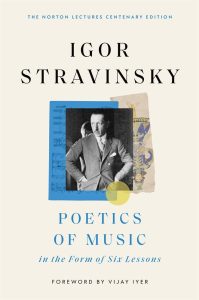
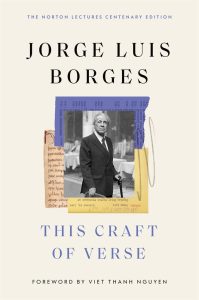
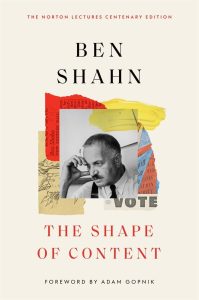
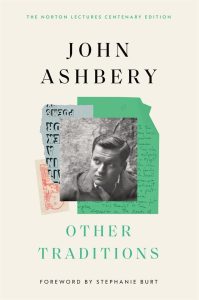
The Charles Eliot Norton Lectures at Harvard University are, if not the most famous, then certainly among the most famous lectures in American letters. Established in 1925, the series asks renowned individuals in the arts and humanities to deliver six lectures. Among those who have given the lectures are plenty of Nobel laureates, including T.S. Eliot, Octavio Paz, Toni Morrison, Seamus Heaney, and Orhan Pamuk, but there are also surprises, like jazz pianist and composer Herbie Hancock, film director Wim Wenders, and the avant-garde artist and musician Laurie Anderson.
How, then does one possibly choose just five lecturers to represent the centenary of the series? In an interview with Publishers Weekly, Harvard University Press editorial director Sharmila Sen answered the question: “From the outset, we knew we had to reflect the series’ historic commitment to literature, visual art, and music. We also wanted books that could be read in one or two sittings, the equivalent of spending an hour or two attending the lectures in person.” Sen added that the editors were looking for “titles that would feel like a discovery to contemporary readers.”
Mission, I would say, mostly accomplished.
The lectures chosen for the centenary, in the order in which they were given, are composer Igor Stravinsky’s Poetics of Music from 1939-40, painter Ben Shahn’s The Shape of Content from 1956-57, fiction writer and poet Jorge Luis Borges’s This Craft of Verse from 1967-68, poet John Ashbery’s Other Traditions from 1989-90, and author and critic Umberto Eco’s Six Walks in the Fictional Woods from 1992-93. Of these, I most enjoyed Ashbery’s Other Traditions and Shahn’s The Shape of Content, although every volume offers plenty of ideas to consider, and it’s worth saying a few words about each book.
In his introduction to Stravinsky’s Poetics of Music, composer and pianist Vijay Ayer acknowledges that while “Stravinsky was an eloquent interviewee, he was not an ardent writer, and scholars have come to understand that his ‘writings’ were in fact co-written with one or more acolytes…. That is not say that these were not Stravinsky’s ideas, or that they went against his nature; the composer gladly presented them as his own voice, affirming that these writings were at least faithful to his thinking.” Oh, and the lectures were originally delivered in French and not translated into English until 1947. However, if we put these oddities aside, it’s hard to resist Stravinsky’s enthusiasm for “the Masters,” like Haydn and Mozart, and his witty impatience with anything he doesn’t like. The “bourgeois irritates me much less than the snob,” he opines in the lecture on musical typology. And in “The Performance of Music,” he tells us “it is not without reason that the worst interpreters usually tackle the Romantics. The musically extraneous elements that are strewn throughout their works invite betrayal.”
According to Adam Gopnik, by the time Ben Shahn delivered the lectures he called The Shape of Content, the painter was already something of a has-been. Shahn’s “stubborn and individual quest to affirm the centrality of subject matter in painting” was considered passé by the abstract expressionists who were then in vogue. Fortunately, Shahn is a lively writer, and as someone whose art was meant to reach “the common person,” he communicates clearly and with gusto. We quickly learn that he is emphatically against orthodoxy and conformity and institutions. While he acknowledges in the lecture “Modern Evaluations” that “beliefs in what constitutes truth change with every generation, with each new great preacher or teacher or cataclysmic discovery or deep revelation,” ultimately what we are seeking from a work of art is “some vague striving for the truth.”
The stories of Jorge Luis Borges frequently take the form of dense, almost impenetrable puzzles. The lectures in This Craft of Verse aren’t nearly as gnomic, although, as suits his writerly personality, Borges is given to concision rather than expansion. “I have never read any novel without feeling a certain weariness,” he admits in “A Poet’s Creed.” “Novels include padding; I think padding may be an essential part of the novel, for all I know. Yet I have read many short stories over and over again.” He tells us, “I have done most of my reading in English,” and though Borges’s examples in his lectures show him, naturally, to be quite familiar with world literature, there are references to Milton and Tennyson, Byron and Wordsworth, George Meredith and Robert Louis Stevenson, and lots of allusions to Shakespeare and Keats. Indeed, the book can feel at times like a memoir crossed with a recommended reading list.
Whereas the lecturers discussed so far tend to divide their lectures into relatively broad topics, Ashbery chose to talk about six poets he loves and feels are unjustly neglected: John Clare, Thomas Lovell Beddoes, Raymond Roussel, John Wheelwright, and David Schubert. Ashbery’s prose feels less worked over than in the other books and more like that of an actual lecture. Moreover, his enthusiasm for what some might consider minor poets is infectious. He quotes generously from the poems, which helps his argument for each poet, but it’s his descriptions of the poems themselves that are most memorable. He praises Beddoes’s “Dream-Pedlary” for its “metrical complications, which are legion despite its deceptive simplicity,” and Wheelwright’s “North Atlantic Passage” is an “ebullient but chaotic soup.” Of Schubert’s “Kind Valentine,” Ashbery writes: “none of this quite adds up, and, in the way of a Schubert poem, it shouldn’t: what we are left with is a bouquet of many layered, splintered meanings, to be clasped but never fully understood.” Readers of Ashbery’s poetry may find that an apt summation of his own work.
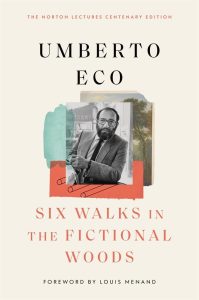
While I admired Umberto Eco’s efforts to categorize and explain “fictional protocols,” as he puts it in his final lecture, I often felt like I was back in graduate school, that I should be taking more notes lest one of his classifications appear on the final exam. That’s not to say that Eco doesn’t have a sense of humor in Six Walks in the Fictional Woods. Alluding to a postmodern detective novel that he never got around to writing, Eco describes the final scene: “Out of the darkness comes a man with a sarcastic smile on his face. It’s Philip Marlowe. ‘Let’s go, Miss Marple,’ he says to the woman. ‘Father Brown is waiting for us on Baker Street.’” And Eco demonstrates how dangerous fiction can be by explaining the process that transformed the obviously fictional Protocols of the Elders of Zion into a “nonfiction” work that became an excuse for violent antisemitism.
The books’ introductions, by current experts in the lecturers’ fields, tend to be brief, but they are uniformly excellent. Each author is enthusiastic about the material and offers tips on how to read it. Of course, listening to a lecture is an inherently different experience than reading a book, but these five volumes give us a sense of what it must have been like to sit in the darkened lecture hall, waiting for that year’s Brilliant Mind to wow everyone with the gravity of its knowledge and insights, along with the lightness of its imagination—those unexpected leaps and turns.