
Georgia
Review by David Starkey
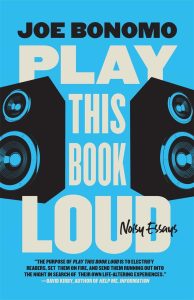
At the bottom of the record sleeve of the original vinyl LP pressing of the Rolling Stones’ 1969 album Let It Bleed is a message to the listener: “THIS RECORD SHOULD BE PLAYED LOUD.” How much you appreciate Joe Bonomo’s new essay collection, Play This Book Loud: Noisy Essays may well depend on whether you immediately get the allusion in the book’s title. That’s not to say that Bonomo’s writing, which is by turns witty, sharp, self-deprecating, recondite, and informational, doesn’t have something for all readers, but Play This Book Loud is clearly aimed at music nerds like the author. Reader, I must admit that this designation applies to me.
Bonomo teaches creative writing at Northern Illinois University, a state university in the cornfields northwest of Chicagoland. It’s an out-of-the-way place, and that’s appropriate, as Bonomo prefers subjects from off the beaten path. There is, for instance, a chapter about Pickwick Records, which in the 1960s and early 1970s specialized in albums of cover songs of recent hits. Advertised on television and performed by a cover band called Kings Road, “the weary substitute teachers of pop music,” the Pickwick songs are, Bonomo acknowledges “decent” for “soundalikes,” but their real appeal to the author is nostalgia. He asks himself if he had “grown up, pre-Internet, on a remote outpost somewhere, a thinly populated island, or a one-light town in far northern Greenland,” would he gravitate toward the original songs, or “would I prefer the ersatz, content in my sentimental love for the off-key singing, pedestrian arrangements, and dull musicians of the songs that scored my adolescence?” His answer: “Kings Road were the million-sellers in an alternate universe. I raise a Cragmont Cola to them.”
Bonomo is similarly fascinated by another collection of songs he learned about through television advertising. Dick Clark/20 Years of Rock n’ Roll features songs by Chuck Berry, Little Richard, Jerry Lee Lewis, the Shirelles, and Bill Haley. Despite the cheesy packaging, the double album contains some of the great early rock songs, and Bonomo becomes quite eloquent when reminiscing about how those songs once made him feel: they evoked a “mystery and emotional complexity” that spoke to him “in language different, and so much more vital than everyday speech.” He continues: “Sometimes a melody would be so moving in its lilt and changes I felt as if I were on the outside peering in at the world of grown-ups, where loss mingled with joy, where I felt the pull toward something weighty, and not altogether welcome, that I couldn’t yet name.” What a lovely evocation of the power of popular music over the mind and heart of an adolescent boy.
Then there’s “A Genius Moment, or an Accident,” which takes a deep dive into a 45-rpm single released by 7-11 in 1966 entitled “Dance the Slurp.” It’s quite a long essay for a novelty song designed to get people to buy Slurpees, but Bonomo is committed to the premise, and we learn perhaps more than we would ever want to know about the song’s gimmicky life.
What else? We have a paean to the Jam’s 1980 album Sound Effects and another to Van Halen’s 1984 single “Panama” and still another to Green Day’s 1995 album Insomniac. Like any good rock writer, Bonomo makes you want to listen to the records he describes. His enthusiasm, conveyed through metaphors and anecdotes and snippets of lyrics, is infectious. He writes an interesting profile of Margo Price, alt-country singer, devotee of LSD, and an NIU alum. He reviews a play about the rock writer Lester Bangs, and revels in Iggy and the Stooges’ cover of “Louie Louie.”
As my chapter descriptions suggest, Play This Book Loud is something of a miscellany, but its subtitle, “Noisy Essays,” holds everything together. Overall, Bonomo comes across as a pretty sensitive guy, but like many sensitive guys with a guitar in their hands (or a computer at their fingertips), he likes to crank up the volume whenever he can.