
University of Arizona Press
Review by Brian Tanguay
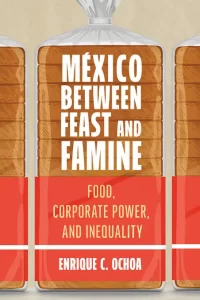
Mexico has a well-earned reputation for culinary excellence, and foodies all over the world recognize its local and regional food cultures. But while Mexico’s age-old techniques and ancestral customs draw praise from affluent consumers and diners in high-end restaurants, millions of Mexicans suffer from malnourishment and food insecurity. In 2010, the United Nations’ Educational, Scientific, and Cultural Organization (UNESCO), noted that nearly 25 percent of the population had insufficient access to food. How the evolution of this contradictory situation came about is the subject of Mexico Between Feast and Famine. Through an extensive and heavily documented inquiry of Mexico’s colonial history, politics, and economics, scholar Enrique C. Ochoa explains how a handful of transnational corporations came to dominate Mexico’s food production and distribution system, and the social consequences of their effort.
At the time of the Spanish conquest in 1519, the country now known as Mexico was a mix of diverse regions and societies, with distinct patterns of life, cultures and epistemologies. Food sources and cooking methods varied by region. In central and southern Mexico the cultivation of maize fostered the development of sedentary communities in which women devoted many hours each day to food collection and preparation. While the European colonists were amazed by the variety and abundance of foodstuffs, they still set about imposing their notions of food and nutrition on the Indigenous population. “After all, to live well by European standards,” writes Ochoa, “meant to consume bread, meat, and wine and not tortillas and pulque, the fermented drink from the maguey plant.”
By the time Mexico gained its independence in 1821, thousands of Indigenous people had perished from disease, traditional foodways had been lost, and ownership and use of land had changed dramatically. Campesino agricultural systems and knowledge had been degraded, but still survived. Production of wheat had supplanted maize and the cultural practices that accompanied its production. But even more changes were in store. “By 1910, foreigners held some 35 percent of all Mexican surface area and more than 60 percent of the nation’s borderlines and coastlines. Overall, fifteen thousand U.S. landowners controlled approximately 27 percent of the nation’s land.”
A succession of Mexican governments used food to enhance their electoral prospects, establishing state-owned production facilities and markets, which operated fairly successfully until the 1980s when the price of oil collapsed and Mexico, like other countries in Latin and South America, adopted the austerity framework imposed by the International Monetary Fund (IMF). In exchange for IMF loans, the Mexican government slashed social spending and began the process of privatizing state-owned companies. By the time the North American Free Trade Agreement (NAFTA) came along in the early 1990s, the privatization process was well underway. Combined, Mexico’s neoliberal response to the economic downturn and NAFTA “strengthened Mexico’s capitalist class at the expense of large segments of the Mexican population.” Foreign brands like McDonald’s and Walmart entered Mexico, and homegrown companies like Bimbo, the ubiquitous baked goods seller, expanded their operations. Well-capitalized corporations bought and absorbed their competitors; small farmers and neighborhood grocery stores couldn’t compete. As happened in many economic sectors in the US, the big got even bigger, more profitable, and able to wield more power and political influence to both enhance and protect their operations from regulation and state oversight.
Ochoa documents the devastating impact Mexico’s neoliberal food regime has had on the public. Traditional foods such as tortillas made from maize, gave way to bread, sweet pastries, junk food, soft drinks, and other processed products, resulting in an increased incidence of type 2 diabetes; political power became concentrated in fewer hands, less responsive to public needs. “Together, the public and private sectors,” writes Ochoa, “have accelerated Mexico’s double burden of malnutrition.” For working-class consumers, Mexico is a junk food paradise. Yet, this system has been enormously profitable for a few, a wellspring for many in Mexico’s billionaire class.
In the framework of the neoliberal era, what’s happened in Mexico isn’t a new story. What makes Mexico’s story different is its history of European colonialism and development, the chauvinism that declared Indigenous ways of doing and being inferior and backward. The knowledge of seeds, soil and climate gathered by Indigenous people over centuries were discarded in favor of an industrial food system, with woeful consequences for people and the environment. If there is a way forward, it will come, argues Ochoa, by democratizing the food system and society.