
Heliotrope
Review by Lisa Del Rosso
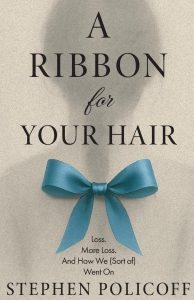
A Ribbon for Your Hair: Loss. More Loss. And How We (Sort of) Went On by Stephen Policoff, is a memoir about the loss of first his wife and then one of his daughters within a three year period. It is a raw and harrowing account of grief spiked with wry humor and what can only be described as reluctant survival.
Policoff is primarily a fiction writer. The novels Come Away and Dangerous Blues are also imbued with grief, weaving in ghosts, folklore, fathers and daughters, and magical thinking. In A Ribbon for Your Hair…the protective sheen of fiction is replaced by the sheer pain of reality.
He sets out what the reader is in for within the first few pages, in the form of bullet points: dates and deaths. In 1995, Policoff and his wife, Kate, adopted Anna, a bright happy child from China. In 2000, when she was five, Anna was diagnosed with Niemann-Pick C, a fatal wasting disease. Doctors said that Anna would not live beyond the age of ten. Anna did, in fact, live until she was twenty.
The first half of the book is a detailed study of two loving parents caring for a child whose condition deteriorates by the day. They adopted a second daughter, Jane, because Anna had long wanted a sibling, and Kate, in despair, said to Policoff, “We need something to hope for.”
In the middle of the book, another memoir emerges: 14 Scenes from a Film I Never Wanted to See. Kate has a horrible cough that gets worse and worse. She sees a specialist. She is diagnosed with lung cancer. As she begins treatment, Policoff’s interior dialogue, which is both blunt and funny, runs to “…I think over and over, Who are we, the fucking Job family?’”
In 2012, Policoff is not only widowed; he is now the only parent left to shoulder Anna’s physical needs. It is Jane’s loss, too: first her mother, then the eventual loss of Anna, who died in 2015. Policoff and Jane are survivors bonded in their sorrow.
There were points where I had to stop reading A Ribbon for Your Hair… wondering how much a person could lose and still get out of bed in the morning. Policoff’s reason to keep going was Jane. Policoff says, “…Jane was only in sixth grade when her mom died; in ninth grade when her sister died. As I write this, she is an NYU graduate with an art-world job. Her year of study abroad was curtailed like everything else in the pandemic. But she has weathered a lot, and seems to find ways to have fun, and lead a (mostly) normal life.” Jane has gone on and thrived.
As for Policoff, he confesses, “How do you move on from this… if you don’t want to move on, because you believe your grief keeps their memories alive?” That line of thinking is fascinating in terms of what you believe grief to be: indefinite. But does it also stop you from living? And what is moving on, anyway?
Everyone grieves in a different way. When the deaths are excruciating, like Anna’s; or sudden, like Kate’s, they are all the more difficult. Personal items help: Kate’s ring, Anna’s ribbons. But who is anyone to say when – or why – to let go? Policoff doesn’t have to. Instead, he has produced an extraordinary memoir, a written word monument, to Kate and Anna.