
Cornerstone
Review by Paul Willis
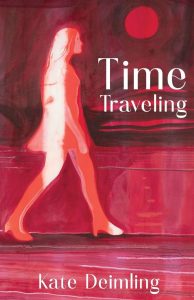
Kate Deimling’s debut collection of poetry travels through the reader’s mind like a stray clock, chiming the hours past, present, and future in a harmony only art can arrange. It begins with poems about her children that merge with poems about her own childhood. Like Lot’s wife, she says, she must look back.
In “The Other Pool,” she recalls an indoor swimming facility “near the seedy side of town,” where “old neighborhood ladies plodded / through the water, mouths surfacing / to open like sedate frogs.” Then, ” Leaving, they loosened the chin straps / on their swim caps, while the lifeguard let / one flip-flop dangle, ankles crossed. / What beauty there was to it all—” What beauty indeed.
In “All the Linden Trees in Bloom,” she recalls riding her bicycle home on the last day of school: “The tip of my ponytail tickles / my neck, and all my muscles / feel taut. Summer—the word / wets my mouth with the tang / of sour candy, bounces / around my brain like the announcement / of a miracle.” Such a passage accomplishes the paradox of particularity, for it is not the freedom of young Kate Deimling’s last day of school that I know, but the wild freedom of my own.
The second section of the book turns from family to nature. The “Magnolia Warbler in Central Park” presents itself as “a tiny tang of light,” its “taut belly . . . flashy as a taxi.” “Hiking to the Waterfall” brings her farther from her urban environs, following markers on the trees like “icons on my laptop.” But taxis and laptops finally dissolve when “skin sealed / with sweat meets the mist,” and “something’s been left / behind, shrugged off.” She has finally, fully entered the green world—not easy to do, I imagine, when Brooklyn is where you call home.
The poems of section three are built on literary and historical allusion. Andrew Marvell, Diocletian, Emily Dickinson, the Brothers Grimm, and even Evil Knievel take turns being addressed or expressing themselves in new ways. In “From His Coy Mistress,” the speaker says she hesitates “to lift my pen / and answer you, most wise of men,” only to complain about suddenly being tossed in the grave, worms chewing on her flesh. But she gives Marvell a comeuppance in the end, offering a witty and accomplished reply in the same vein as Sir Walter Raleigh’s famous response to Christopher Marlowe’s passionate shepherd.
The retired Emperor Diocletian gets his own villanelle. (Deimling is also a translator of French literature.) Begged by officials to resume power, he tells them, repeatedly, “You should see these cabbages of mine, / massive, stretching in an endless line.” Perhaps the most original poem in this series, “Duel,” records the thoughts of first a journalist, then an aristocrat, as they enact their fatal encounter: “He heard the blast, smelled the sting / of sulfur and metal, and saw / smoke waft away / as from an extinguished candle.”
Allusions continue in section four, and some of them begin to tire. In “Satisfaction,” the poem begins, “About desire they were never wrong, / the Rolling Stones: how well they understood / not getting what you want.” I’m not sure that Auden wanted anything to do with this, actually. William Shatner, Alfred Hitchcock, and Marianne Moore get their shout-outs as well. I like Deimling’s poems a bit better when they stand on their own two feet.
Which they can. And do. The fifth and last section of the book ends with some of the strongest poems in the collection. “To the Figure Skater Who Fell” is composed of limpid tercets in which each line is shorter than the last, the athlete’s body “toppling in random configurations, / like groceries tumbling from / a torn bag.” “Why I’m Making Scones” responds to another fall—that of a college friend from a window, now eerily recalled in the kitchen: “A crack, and the shell splits, / yolk wobbles on a mound of flour.”
The last two poems in the collection, “Thin Times” and “Waiting for the Subway,” come back to the overarching theme of moments that merge and collapse—”when, folk wisdom has it, the boundary / between worlds grows loose as a spider’s web / stretched in dew.” And, back in Brooklyn, when the subway train finally approaches, “a spot glows right in the center with spiky bursts / like a child’s crayoned sun. / Hold that moment in your mind, / the beam you called forth as if by force of your will, // before it divides into two focused eyes staring you down / and the subway proves the rules of perspective / once more, rumbling up to the platform to fetch you / and move you forward, always forward, into the future.” I can only hope that Kate Deimling will keep moving forward into her own promising future as a uniquely gifted poet—a poet, like Robert Herrick of old, of times trans-shifting.