
St. Martin’s Press
Review by Brian Tanguay
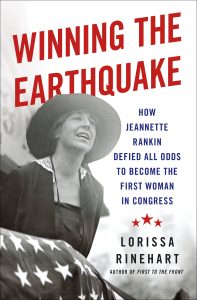
Barbara Lee, a Black Congresswoman from California, cast the sole vote opposing the Authorization for the Use of Military Force after the 9/11 terrorist attacks which allowed the Bush administration to invade and occupy Afghanistan in 2001 and Iraq two years later (arguably the greatest strategic blunder in American history until Donald Trump’s illegal war of choice against Iran). Whether or not she realized it, Lee was following in the principled footsteps of another woman, Jeannette Rankin of Montana, the first woman elected to Congress, who famously defied prevailing opinion to vote against America’s entry into World War I, expansion of the military draft in 1939 and the Declaration of War against Japan in 1941.
Among other things, historians tell us who deserves to be remembered and why. American history until fairly recently has largely been told through the lives and deeds of white men. Before reading Lorissa Rinehart’s impressive biography of Jeannette Rankin, I regrettably knew Rankin only as the first woman elected to Congress. While that is a significant milestone, Rankin deserves far more recognition for her remarkable, ground-breaking life. How could such a courageous figure be forgotten? Not only is the answer revealing about America’s past and present, it serves as a lesson about the consequences of standing against entrenched power structures.
Rinehart tells this story with passion, and her prose captures the “force of nature” personality of her subject. Jeannette Rankin was born in Montana in 1880, when life in Big Sky country was rugged and children were expected to contribute, feeding chickens, splitting firewood, mending fences and caring for livestock. At the same time, there were horses to ride, mountain canyons to explore and pristine creeks to swim in. Rankin’s father, John Rankin, an enterprising and resourceful man, owned and operated a sawmill at a time when demand for lumber was needed by the army, settlers and the Northern Pacific Railroad. The Rankins became one of Montana’s wealthiest families. By the age of twelve, Jeannette was helping her father with the family business; she had a mind for creating systems and structures that would serve her well when she entered politics. In addition to this practical experience, Jeannette imbibed what one might call “classical” values: wisdom, courage, moderation and the idea of the greater good. Early on she witnessed the brutal treatment of Native Americans and the exploitation of working men and their families at the hands of the powerful Anaconda Copper Mining Country. Despite her relatively privileged upbringing, Jeannette was predisposed to stand with the less fortunate, the downtrodden and the oppressed.
Working for political and social change is often a lonely endeavor, filled with setbacks and disappointments. American women learned this lesson as they organized, advocated and agitated for the right to vote, a campaign that didn’t bear fruit for nearly a century. Rankin was a tireless and effective speaker and lobbyist for the cause of women’s suffrage, but she campaigned with equal vigor for the right of workers to organize and join labor unions, for an end to child labor, and for the expansion of democracy, positions which placed her in opposition to the most powerful economic and political forces of the time. This hasn’t changed. Efforts to curb the power and privilege of the wealthy or more equitably redistribute the fruits of society are still met with ferocious and sustained opposition.
As diligently as Rankin toiled for female suffrage, union rights and democracy, she worked even harder for peace. A staunch and unrelenting pacifist, Rankin believed that the decision to engage in armed hostilities, to commit the lives of young citizens to the horrors of warfare is, or should be, a solemn one taken only when a nation has exhausted all peaceful means. American history is in many respects a history of almost continuous warfare. When Rankin rose from her seat in Congress and voted against American entry into the First World War, she angered women who had been allies and men she considered supportive colleagues; when she opposed expanding the draft in 1939 and the declaration of war against Japan in 1941, she stood against a powerful tide. Each time she voted her conscience and conviction, Rankin knew she would be excoriated in the press, belittled and shunned.
And, ultimately, deemed unworthy of remembrance. The courage Jeannette Rankin displayed throughout her long and meaningful life is rare. One can only admire a woman willing to stand up when everyone else sits down, to voice dissent when others remain silent, and to knowingly take the rough path of conviction rather than the easy path of convenience. Imagine if more contemporary political leaders conducted themselves by Jeannette Rankin’s unbreakable moral compass. Our country might be a more peaceful, democratic and egalitarian place.