
Avid Reader Press
Review by Brian Tanguay
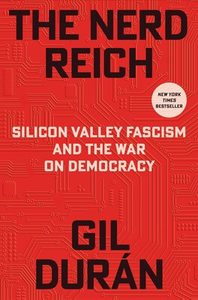
For a relatively brief period the movers and shakers of Silicon Valley appeared to offer products that would make our lives more efficient, convenient, and connected; every new platform and application seemed to offer freedom scaled to each individual. Silicon Valley wizards were the good guys of a new and promising age. Has Silicon Valley changed or were troubling signs present from the very beginning? In The Nerd Reich, journalist and political consultant Gil Durán explains how we arrived at a moment when Silicon Valley oligarchs are acquiring land, resources, and power all over the world in order to impose their ideas of tech fascism. According to Durán, the billionaires are racing to build a “post-American authoritarian dystopia.” Strong words indeed, but backed up by considerable research and incisive writing.
“When a nation is betrayed by its wealthiest citizens,” Durán writes, “men who believe their money and technology entitle them to rule — existential crisis follows.” Understanding the right-wing radicalization of Silicon Valley requires becoming familiar with investor Peter Thiel, and how Thiel’s political outlook was shaped by a book published in 1997 by James Dale Davidson and William Rees-Mogg. In The Sovereign Individual: How to Survive and Thrive During the Collapse of the Welfare State, Davidson and Rees-Mogg predicted that the Internet would make the mediocre middle-class expendable and render the uneducated a pauper class. Nations, they argued, would become antiquated, and elite individuals would no longer swear allegiance to a country. Thiel embraced these ideas with the fervor of a religious convert and in public musings praised the technological forces pushing toward digital currencies and a world of limited government with limited tax authority. Once viewed as eccentric and unserious, the thrust of The Sovereign Individual now influences American public policy at the highest levels of decision making.
But Peter Thiel wasn’t a lone evangelist. Durán introduces readers to Curtis Yarvin, once an obscure blogger who gained international notoriety for proposing to replace American democracy with a corporate dictatorship. Yarvin’s fringe musings struck a chord with Peter Thiel and with Thiel’s patronage, gained wider currency. According to Durán, Curtis Yarvin matters “because he provides a window into the souls of men who now control vast amounts of American wealth and power.” Another venture capitalist, Balaji Srinivasan, mined The Sovereign Individual and Yarvin’s more extreme views and burnished them for mainstream consumption. Srinivasan called for replacing democratic governments with networks of corporate governments. Other Silicon Valley players, like Elon Musk and Marc Andreessen, gave these anti-government ideas additional legitimacy.
After mapping the intellectual origins of tech fascism, Durán discusses how the tech oligarchs have infiltrated national politics with massive campaign donations and lobbying for crypto currencies like Bitcoin. Should Americans be concerned that Donald Trump and his family have become enthusiastic believers in crypto? In Durán’s view we should: “The idea of a crypto billionaire president is alarming when you consider crypto’s true purpose. At their core, cryptocurrencies are designed to challenge government authority by competing with it.” Durán considers Bitcoin a Ponzi scheme that depends on convincing people that its value will continue to rise. But if it doesn’t and the industry collapses of its own excess, will crypto investors turn to the taxpayers to make them whole? Who can forget “too big to fail” Wall Street banks?
Peter Thiel is fusing business, politics, and religion into a potent power and his reach extends to the White House. Vice President JD Vance is a Thiel acolyte. Durán calls Vance a creation of Peter Thiel. It was Thiel who gave Vance his start as a Silicon Valley venture capitalist, and Thiel who bankrolled Vance’s Ohio senate campaign. What Vance lacks in principles and charisma is offset by his relationships with Thiel and other tech billionaires.
The Nerd Reich connects a number of important dots, and appears at a moment when AI is sucking up venture capital and a handful of companies are racing to build massive data centers. The pace of AI deployment has alarmed the general public and sparked nationwide protests that cross partisan boundaries. Twenty-five years ago the greatest threat to the United States came from external actors; today, the threat to liberty comes from the antidemocratic dreams of billionaires whose wealth and control of information allows them to manipulate our politics to further their interests.
Gil Durán concludes that we can have a democratic republic or a billionaire class, but not both. “If we continue to allow a tiny group of men to stockpile the majority of the world’s wealth,” he writes, “they will continue to buy the power they need to impose hierarchy, oppression, subjugation, and death on the vast majority of people, whom they see as their inferiors.”