
Verso
Review by Brian Tanguay
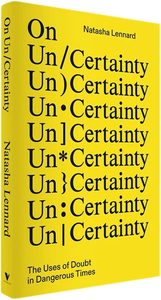
Natasha Lennard lays out the aim of On/Uncertainty in the first few pages: she seeks to track pernicious certainty in action to understand how it infiltrates some of our world-ordering certainties, such as white supremacy, hard borders, property rights and ethnonationalism. When such certainties are thought to be foundational, how can we change them? Reason, debate and evidence are rarely sufficient, so what are we left with?
A professor of critical journalism and a columnist for the Intercept, Lennard employs a philosophical lens developed by Ludwig Wittgenstein in his posthumous book On Certainty. Lennard takes readers on a brief tour of doubt, certainty, and knowledge. Wittgenstein, who Lennard calls an unlikely theoretical guide for contemporary leftists, “exposes the workings of certainty and doubt by drawing attention to language games in which the activities of being certain or having doubt are necessarily embedded.” One of Wittgenstein’s paradoxes is that doubting itself presupposes certainty. If this seems abstract, don’t worry, Lennard makes her argument in more accessible language.
We seem to be living through a moment of permanent crisis: climate destruction, mass migration, genocide, and wealth inequality. These trends can appear permanent and inescapable, but Lennard reminds us that they are the result of decades of policies, habits, norms and violence. Taken together, it all seems too much, too entangled and embedded to remedy. What habits and practices would we have to adopt to change a global trajectory? One encouraging idea Lennard notes is that we’re not starting from scratch, and she points to the informal, spontaneous mutual aid networks that came into being during the Covid pandemic, the many collective actions to help vulnerable neighbors, workers and tenants. Earlier this year, the citizens of Minneapolis provided a powerful example of solidarity as they resisted Donald Trump’s deportation forces.
Not that long ago liberal centrism seemed solid and permanent, but that supposedly robust framework fractured rather quickly when assaulted by authoritarian populism. The outcome of social revolutions is never certain. Uprisings are routinely squashed by violence. Midwifing significant change is a long game, and no single method works; overcoming a ruling edifice requires pushing and shoving at it from all sides over time.
This short book stands as a stark reminder that we move through uncertainty with hope sustained by collective action. As Lennard puts it, “There, on some of the harshest of terrains, we have been shown what it is to go on.”