
Europa
Review by Walter Cummins
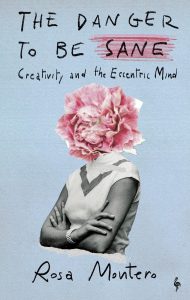
Novelist Rosa Montero opens this book with an admission that “I’ve always known something in the head didn’t work right,” then illustrates with her age six obsession that her mother hide a little copper pot at night so she couldn’t find it and poison herself with a lick. She then goes on to conclude that her eccentricity is inseparable from her creativity. As suggested by the book’s title—lines from Emily Dickinson—she considers a safe sanity a threat to that creativity.
She offers many examples to verify that a large number of creative writers are linked to a variety of strangenesses. Aware of their conditions, some seek help. Here’s an example I observed. One afternoon during the post-lunch informality at an MFA residency, I sat with a group of students and faculty comparing the SSRIs they were taking, mainly Wellbutrin because it does not affect libido. Several, as if to score points, announced that they were also on Paxil. It was a happy discussion, at least on the surface.
Psychic help—including therapy—appears to be a need for a good number of writers, who are open about it. One friend of mine, a prize-winning poet, contributed an essay about her treatments to a book called Poets on Prozac, joining the admissions of a group of peers
To verify her claim that writers are prevalent in mental instability, Montero compiles a list of weird behaviors: “Agatha Christie wrote in the bathtub; Rousseau was a masochist and exhibitionist. Freud had a phobia of trains; Hitchcock, of eggs; […] Rudyard Kipling could only write in very black ink, to the point that he considered blue-black ink ‘an aberration.’ Friedrich Schiller kept rotten apples in a desk drawer because he needed the smell of putrefaction in order to write. In her old age, Isak Dinesen ate nothing but oysters and green grapes with the occasional asparagus; Stefan Zweig was an obsessive autograph hunter, sending three to four letters a day to his favorite personalities asking for their signatures.”
Montero cites the result of a study by Nancy Andreasen, a psychoanalyst at the University of Iowa, that “writers are four times more likely to suffer from bipolar disorder, and up to three times more likely to suffer from depression than non-creative types.” Andreasen conducted long interviews with a number of Writers’ Workshop faculty, all famous names, several who had been institutionalized and yet managed to turn out major works.
Her own history of panic attacks and other crises, along with her knowledge of the biographies of many writers, led Montero to write this book about creativity and mental illness. She also engaged in “self-analysis of my own leaky head” and consulted with and read books by many psychiatrists, psychologists, and neurologists. An additional incentive for her exploration was a Swedish study that indicated writers were 50% more likely to commit suicide than the general population.
She gives attention to a number of author suicides like those of Virginia Woolf and Sylvia Plath, whose conditions she explores in compelling detail. She also compiles lists of writers who were severe alcoholics, including important American Nobel Prize winners, as well as “opium addicts, cocaine users, and junkies of all sorts.” She also names some who had been in mental institutions, along with others who should have been.
Much of her material on writers who were addicted or insane or suicidal focuses on famous names, including some of the most significant writers of our time. Montero emphasizes these cases, possibility because they are so dramatic and show that extreme disorders can still be coincident with major works.
But this focus on the sickest may lead some readers may come away assuming that writers overall are deeply crazed. In fact, the great majority of writers are functional despite any compulsions and obsessions, as Montero herself is, a well-known Spanish prize-winner despite admitted oddities. She proposes that such unique quirks, particular to individual writers, are likely a central source of their creative imaginations. While many people will contend that there is no such thing as normality and that all people have quirks, those of creative writers may serve a creative function, leading to imaginative insights when perceiving the world around them. Montero cites Emmanuel Carrère on the major distinction of living like a writer: “ I don’t have direct access to experience, I always have to put it into words.”
Montero makes a related point when considering an early trauma as the source of the defensive dissociation of many writers: “In all of us, then, there would be a tormented self and a self that observes—and the observing self is the one that writes.”
Referring to the theories of neurobiologist Mara Dierssen, Montero regards the most important difference between those who are disturbed and the disturbed who write is that non-writers focus their attention narrowly and miss opportunities to make unique associations. It’s such original insights that are the source of creativity.
Montero concludes, “What’s wonderful in writing is to feel yourself within other individuals. Fiction is a journey into the other, and it is the most fascinating journey one can make.”