
Farrar, Straus and Giroux
Review by Laura Mullen
“Then the rain came and we thought it / might clean us. / It did not clean us.”
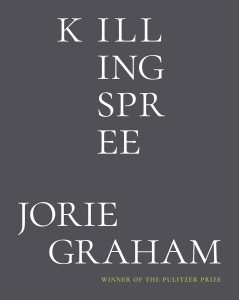
In his Theses on History, Walter Benjamin described a painting by Paul Klee in which the angel of history faces the storm of “progress” that piles debris skyward; Lucy Sante, in her memoir, Maybe the People Would Be the Times, found such angels among her contemporaries: “Some of us…see the ever-growing wreckage piled up at our feet, wreckage we cannot look away from, the detritus of so-called civilization, and we wonder if we are not being propelled…toward the collapse of time.” In The Peripheral, William Gibson describes this collapse as the “Jackpot,” an “androgenic” catastrophe (“systemic, multiplex, seriously bad shit”), “with no particular beginning and no end.” The onset of Gibson’s Jackpot is what poet Jorie Graham, in her 17th collection, calls the Killing Spree, demonstrating once again her lucid vision and remarkable ability to name rapidly shifting realities. If the storm of progress seems, by now, a Category 5 hurricane, and our world a flooded detention center, Graham knows the poet’s job is still to “speak”—even “from a cage” amid other “cages.” Even if we are “Unable to tell our heroes from our tormentors,” “There must be a record / of what we’ve lived. Or that / we lived,” Graham declares. Under the cold hard rain which is the payoff for centuries of bad decisions and worse behavior (a “spree” of greed, wanton destructiveness, lies, theft, violence, and murder), the poet unfurls her eloquent attention, formidable intelligence, and an exemplary capacity for response—qualities that make each new book from this author essential reading.
Because Graham teaches at Harvard, and is justly celebrated (having, in a long and productive career, won every literary prize worth winning while consistently expanding the possibilities of her field), it would be easy to assume her work is a known quantity to all readers of poetry in America and beyond. But having recommended Killing Spree to a local and fairly serious young poet to whom her name meant nothing (I got back a text saying, “What’s it about?”), it seems clear that assumptions about shared cultural literacy are probably, in 2026, a mistake, and so a few words of preparation may be useful. You should know, for instance, that Graham leans into Stephen Mallarmé’s sense of the book as one long poem: to really experience the force of the narrative and emotional arc you will want to read Killing Spree from start to finish. Don’t be afraid to read quickly, however: speed is part of the book’s form (note those right-justified lines rushing toward the page’s edge), as well as its content:
Oh, the future said, this train can go faster than the track can withstand,

why not,

we’re heading out,

it’s speed which is carrying us now,

the vehicle is an illusion,

the bend up ahead you keep squinting into, you can

forget it,

after the bend, wonders, after the bend

the soul will be made to expand...
But be sure to pause where you need to for the feelings her lines will conjure: deeply spiritual without being tediously religious, Graham writes from and to the soul. She does not, however, stoop to “uplift,” nor does she have any truck with the pieties which inform the work of Mary Oliver’s followers: that all too common contemporary poetry move that says yes-the-world-is-bad-but-look-at-these-beautiful-flowers (or real estate) is off the table. (The most glowing, resonant, scene of domestic peace we encounter in Killing Spree—“in the lull / before history dissolves”—turns out to be a description of an 1898 painting by a long-dead French artist.) While we have not yet entirely demolished the lovely, beloved, world of “trees” and “birds,” Graham never loses sight of the precariousness of the natural world under the stresses we’ve put on our shared planet.
All of which is to say that if you believe poetry’s job is to refuel the gratitude attitude and smooth the edges of widening denial this book is probably not for you. If, on the other hand, you agree with Ezra Pound that “Poetry is news that stays news,” and if what cheers and inspires you is erudite intelligence, dramatic courage, and gorgeous language, if you breathe easier for getting facts channeled through a poetic voice of impressive force and flow, this is the collection you’ve been waiting for. Positioning herself as a hybrid of oracle and reporter, channeling and sharing urgently necessary information, Graham’s work is profoundly documentary. And although she poses here—in a poem for her father (the journalist Bill Pepper)—journalism and poetry against each other, what separates the two modes seems less the poet’s ability to “cry out,” than her willingness to rest with uncertain meanings (what Keats called “negative capability”), and ask questions whose answers are “disappeared without / actually dis- / appearing.” If, “It is,” as William Carlos Williams claimed, “difficult / to get the news from poems,” Graham (who has that quote by heart) knows “men die miserably every day / for lack / of what is found there.”
Open Killing Spree, then, like you would open a (really good) newspaper: to learn about “The World” (the title of the book’s opening poem). Claiming the largest possible territory for her subject at the book’s start, the poet then demonstrates (in an immediate and elegant lesson about perception, subjectivity, and how much work can be done by syntax and enjambment), that the world we want to understand is, to some extent, within: created and sustained by attention.
THE WORLD

didn’t change much

at first. At

first it

didn’t change


much, at first I

didn’t—I don’t—

change much.

At first we


didn’t & they
Notice how deftly, carefully, Graham is moving here from macro to micro: from “The World” to the aperture of perception with which we are constantly registering everything. Notice too how swiftly she engages the question of change: not whether things change, but how much and how fast, and who feels it and how. And see how rapidly the troubled interdependence of self and other emerges as subject matter, as the poet traces perception from an objective or disembodied perceiver through an “I” to “we” “& they.” Reading closely and paying attention to attention itself will profit those for whom Graham’s voice is a treasured and trusted part of the field of literary experiences and those for whom this book will be an introduction to her work, because it is the action of attending which Graham is modeling for us. But this is not mindfulness—unless you want to say that Marie Curie or Ada Lovelace or Jane Goodall were “mindful”: this is a focused inquiry at once individual and social. Claudia Rankine, describing the poetics of the poet Myung Mi Kim, reminds us that the poet, “did say that the poem is really a responsibility to everyone in a social space. She did say it was okay to cramp, to clog, to fold over at the gut, to have to put hand to flesh, to have to hold the pain, and then to translate it here. She did say, in so many words, that what alerts, alters.”
In The Peripheral, the chaos and horror of “the Jackpot” is described by someone on the other side of that disaster to someone only headed toward it: still able to make some moves to avoid tragedy. Gibson’s character is, in other words, like Gibson himself—and like Graham—hoping to alert (us), and to alter some “seriously bad shit.” In that book, as in life, hearing the truth isn’t easy, but knowledge and courage are vital, and Graham, like Gibson, is honest about what’s ahead of some of us and already arriving for others.
...Go ahead. Try to posit

the future. It’s

just down there she sd, he

sd, the bodies torn to


pieces sd...
“Not everything that is faced can be changed,” James Baldwin noted, “but nothing can be changed without first being faced.” “I must speak / what is in my heart,” Graham says, adding, “I don’t know / if there’s anything left now in / my heart.” It is clear that the poet’s sense of her work in the world is to look both inward and outward, in order to help us face and potentially ameliorate the catastrophe toward which our Killing Spree propels us—and that makes Graham’s work essential and enriching right now.