
Bloomsbury
Review by Brian Tanguay
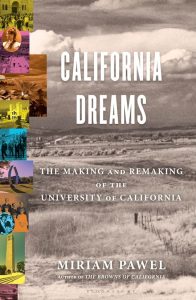
As Miriam Pawel writes in the Preface to her superb history of the University of California system, the many aspects of this educational juggernaut defy precise quantification. UC campuses are home to record numbers of Nobel Prize laureates and a workforce that makes the UC one of the largest employers in the state, while UC alumni are leaders in government, law, education, business, agriculture and technology. What makes this book exceptional is the way Pawel captures human dimensions that afford a fuller panorama of the many ways the state and the UC are linked. The number of campuses, students, patents and academic prizes is a stunning achievement, based on a critical founding proposition: that a liberal arts education should be available to the many, not only the privileged few. California Dreams tells a story of grand ambition and foresight unfolding during war, economic boom and bust, student unrest, political upheaval, tax revolt and demographic change. “Unravel any thread in modern California history,” writes Pawel, “and eventually it leads back to the University.”
Covering every aspect of the UC system, its hospitals, professional schools, athletic teams, and national laboratories would require several volumes. Pawel focuses instead on undergraduate education and access, following five graduates from the founding in the nineteenth century, through the expansion and controversies of the twentieth, and into the challenges of the twenty-first. Milicent Washburn Shinn may not be as well known as Clark Kerr or Kenneth Bailey, but her experience at Berkeley led to a pioneering role in the new discipline of child psychology. Shinn benefitted from the fact that the UC admitted women, though admittance and acceptance were very different things. Male faculty and students treated women as curiosities and referred to them as “bluestockings.” Shinn was one of forty-three graduates in the class of 1880.
David Alan Masumoto was a third generation Japanese American, born in the middle of farm country in the San Joaquin Valley. Shortly after President Roosevelt issued Executive Order No. 9066, Masumoto’s forebears were rounded up and incarcerated in Arizona, at the Gila River Relocation Center. David was intrigued by Cal due to the notoriety of its student activism, protests and social ferment. By the time David matriculated in 1972, the activism of the 1960s had reshaped the campus. Clark Kerr famously summed up that era — and perhaps foretold something about our own — when he said, “The University is not engaged in making ideas safe for students. It is engaged in making students safe for ideas.” Masumoto was attracted to radical politics and experimental courses — worlds he wouldn’t have encountered had he remained in the Valley. Years later, Masumoto wrote a regular column for the Fresno Bee, and several books about his father and the family farm.
Jose Manuel Alamillo arrived in California at the age of seven. His family lived in a small house surrounded by citrus groves. “Joe” as he was known, had never been on a college campus until he spent two weeks at UC Santa Barbara the summer before he started high school. Alamillo was one of more than a thousand students who relied on the Educational Opportunity Program for help with academic support and financial aid. EOP and other outreach efforts came about because UC faculty recognized California’s changing demographics. Programs like EOP increased the number of Hispanic undergraduates and tenure track faculty members. Joe Alamillo made the Dean’s List at UC Santa Barbara in 1992.
Pawel’s source materials are deep and broad: oral histories, Regents meetings, letters and archives, media reports and an impressive array of books. Her decision to weave UC history around a handful of individuals focuses this bounty of material, but it’s her narrative prowess that makes it compelling. Little wonder that her work has earned her numerous awards and critical acclaim. Pawel presents a sweeping story of an institution that sits at the heart of California, defining the state’s ethos and identity more than any other. California Dreams makes an immense contribution to our understanding of the Golden State.