
Heyday
Review by Brian Tanguay
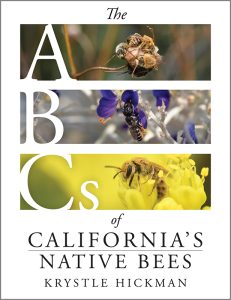
I always enjoy learning new facts about my home state. Prior to reading The ABCs of California’s Native Bees, I had no idea that California is home to more than 1,600 species of bees, or that some native bees are specialist pollinators, meaning that females collect pollen from only one type of flower. The San Jacinto Cryptanthia-Mason Bee is one of these specialists, as it only gathers pollen from the Cryptantha flower. Author, community scientist and photographer Krystle Hickman found the San Jacinto Cryptantha-Mason Bee on a section of the Pacific Crest trail. This small bee is thought to nest in cavities such as holes in wood.
Facts like these make this book a fascinating read for anyone interested in the natural world, but what makes the book beautiful are Hickman’s superb photographs. Hickman traveled widely in search of rare species, from the Colorado Desert to meadows in the shadow of Mount Shasta to Santa Rosa Island. As she traveled, observed and photographed she came into contact with conservation activists, scientists and people practicing regenerative gardening. These encounters added to her storehouse of knowledge. We tend to think, for instance, that the common honey bee, which has existed in North America since 1622, is the species most at risk of extinction, but in fact native bees are most imperiled. We might assume bees live in colonies, but many are solitary and build their nests underground. About thirteen percent of bee species worldwide are parasitic. Unlike male honey bees which die after mating, many male native bees can mate multiple times without dying.
Many bees, many variations.
As the title implies, the book is organized alphabetically. Hickman starts with the Agile Longhorn Bee, usually found hovering around sunflowers, asters and daisies, and concludes with the Zone-tailed Banded-Mining Bee, a high-elevation species she found on Palomar Mountain in San Diego county. The way the book is structured gives it the feel of a journey.
Be warned. This book might induce readers to become more careful observers of bees, seek venues for nature walks or become curious about native plants. As with most aspects of nature, the more we immerse ourselves in it, the more we appreciate its complexity, beauty and diversity.