
Bloomsbury
Review by Brian Tanguay
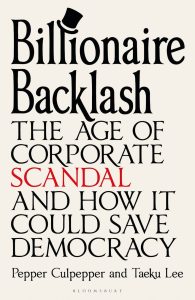
A fundamental political question lies at the heart of Billionaire Backlash by Pepper Culpepper and Taeku Lee: who makes the rules? Is it individual billionaires and the CEOs of multinational corporations, or citizens who consent to being represented by politicians? For most of the twenty-first century billionaires and corporations have been in the ascendancy. Using their wealth and lobbying power, they have enjoyed years of low tax rates and mild regulatory obligations. The Big Beautiful Bill passed in July 2025 by the Republican-controlled Congress was a boon on both fronts.
Sometimes the only thing that goads our political leaders into action is wrongdoing too egregious to ignore. Culpepper and Lee investigate why some corporate scandals arouse public outrage and drive political reform and others do not. Unlike political scandals, corporate scandals frequently spark moral reactions that cut across partisan political lines. Citing examples from Europe, South Korea and the United States, Culpepper and Lee theorize that a fusion of three elements are necessary: emotions, information, and existing public opinion. In the alchemy of scandal, anger is the emotion that most reliably compels citizens to act. Information must be clear and understandable enough for the public to recognize that someone is being harmed or taken advantage of. And a certain amount of latent public opinion must exist. When all three come together, political change that might have seemed unlikely becomes possible, as happened in the United States in 2008 when evidence emerged that Goldman Sachs had bet that the mortgage-backed securities it was selling to clients would fail. The securities did in fact fail, netting large profits for Goldman Sachs, but also contributing to public anger against Wall Street banks. Although the securities themselves were complex and difficult to explain, the public grasped the essential fact: Goldman Sachs had scammed its own clients. At the same time, there was sufficient reporting about the risks Wall Street banks had taken and the consequences for ordinary people. Millions took it on the chin, losing their homes or 401Ks, while the banks were bailed out by the federal government. Anger, information, and public opinion all came together. In 2010, Congress imposed stronger restrictions on big banks by passing the Dodd-Frank legislation.
But not all corporate wrongdoing produces enough backlash to create political reform. The authors present the case of Exxon, which for many years ignored the warning of its own scientists about fossil fuels and climate change. Exxon consistently argued that the science was incomplete, uncertain and inaccurate. Senator Sheldon Whitehouse spent a decade warning his colleagues about Big Oil, and introducing bills that failed in the face of fierce lobbying by the oil industry. While public concern over climate change existed, the issue didn’t generate strong emotions. Surveys indicated that Americans wanted some regulation, but not drastic regulation. Since the early 1990s, Republican voters have become more sceptical about climate science and less inclined to invest taxpayer dollars to implement climate policies. In 1992, the environment wasn’t a polarizing issue; by 2015 it was one of the most polarized. Legislative fixes stalled. Today the Trump administration is dismantling a host of climate initiatives.
In a highly polarized era the bar for creating political change is very high. What are citizens to do when their government is neither accountable or responsive to their legitimate needs? The authors opine that good populism that harnesses latent public anger and frustration can be a catalyst for action and change. But good populism not only requires effort from citizens who accept the responsibilities of citizenship and recognize their own agency, but share a common understanding of the sources of their discontent. While I agree with the authors that a flawed and imperfect democratic house is preferable to a shiny authoritarian mansion, I fear the strangling grip of the past decades’ malevolent populism will be difficult to overcome.