
Chicago
Review by David Starkey
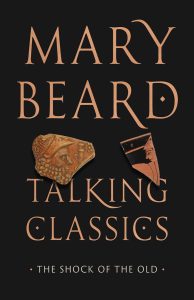
If you thought the Greek and Roman classics were stuffy but serious and timeless guides to the Good, the Beautiful, and the Wise, Mary Beard is here to tell you that you’re wrong: “Debate, disagreement, and questioning are what classics have to offer, not certainty, truth, beauty or relevance in the way that people often imagine.” In Talking Classics, the Cambridge University professor emerita, BBC television presenter, and author of the bestselling SPQR: A History of Ancient Rome, has yet another go at introducing contemporary readers to a world that, as her book’s subtitle suggests, inspires “The Shock of the Old.”
Beard has already written, co-authored or edited nearly two dozen books on ancient history, so finding something new to say requires a bit of ingenuity on her part. Her strategy in Talking Classics is to go against the grain of whatever she thinks most people assume about her subject. So, in what began as a series of lectures at the University of Chicago, Beard dismantles her subject, though in a decidedly cheery way.
For starters, she acknowledges, “There is a lot in the classical world that I deplore. No rose-tinted spectacles can obscure the slavery, for a start, nor the misogyny and the almost unimaginable violence, from battlefields to murderous games in the amphiteatre.” Later, she undercuts the accepted use of the Roman phrase Civus Romanus sum, “I am a Roman citizen.” Rather than a proud statement of belonging, as it was famously used in JFK’s 1963 speech at the Berlin Wall, the phrase, Beard tells us, only occurs once in surviving Latin literature, when an innocent Roman citizen is about to be put to death by a corrupt ruler. Her summary of the story: “The fact is that civic liberties are often most loudly claimed when they are being most gruesomely undermined.”
The third chapter, “Rights and Wrongs,” begins with a recounting of Hitler’s 1938 visit to Rome where he was escorted by Mussolini to see the glories of the Roman Empire. It was a comically ugly bit of tourism. Unfortunately, Beard argues, even when someone like Mussolini, or the far-right racists intent on sidelining “every other cultural tradition in favour of ‘Western civilization,” take unjust control of the past, the rest of us are forced to include their views as part of our own, whether we like it or not. As she tells it, she’s been battling against similarly dominant narratives most of her career. Recounting her early time as a scholar, when 90 percent of those studying the subject were men, Beard discusses her own struggles not only to enter the field but—and perhaps this accounts for her success—not to be boring when writing about the classics.
In the fifty years that Beard has spent with the ancient Greeks and Romans she has found them “admirable and repellent in equal measure,” but she has also found them “unfailingly interesting and empowering.” Her final chapter makes “a case for classics,” including a pitch for learning Greek and Latin to avoid putting “yourself in the total control of the translator, or in the control of a teacher who will tell you that (but not why) one translation is better than another.”
Beard ends by dedicating the book to a nameless curator at the British Museum she briefly encountered back in 1960, when she was visiting for the first time and was stretching on her tippy-toes to see what was inside a glass case. The curator stopped, took out his keys, unlocked the case and held, just a few inches from her nose, a piece of 4,000-year-old Egyptian bread. “Never underestimate how powerful the simple act of unlocking a museum case can be,” Beard says, clearly intending that her book serve a similar function for those of us—practically everyone, if we’re honest—who know less about the classics than she does.