
Citadel Press
Review by Brian Tanguay
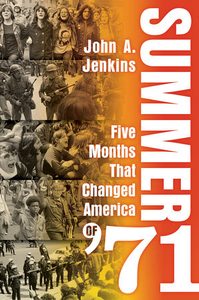
I was twelve years old in 1971 and oblivious to much of the social and political turmoil happening in Washington D.C. and on university campuses. My working class family wasn’t political, and I can’t recall any dinner table discussions about the war in Vietnam, Richard Nixon, the Attica prison riot or the arrest of Angela Davis. I imagine my conventional parents would have sided with the authorities rather than long-haired students or the Black Panther Party. In Summer of ‘71, journalist John A. Jenkins takes a deep dive into five months of that eventful year. With the help of a team of researchers and source materials that take up more than fifty pages, Jenkins examines how the country was tearing itself apart.
By 1971 the Vietnam war was hugely unpopular and far from being over, despite assurances from the Nixon White House and the Pentagon that victory was in reach. These were essentially the same assurances that Nixon’s predecessor, Lyndon Johnson, had issued before the war convinced him not to seek reelection. The dramatic publication of the Pentagon Papers, a secret study of America’s involvement in Southeast Asia, told a different story. Jenkins devotes considerable space to the Papers and the key actors in their eventual publication: the whistleblower Daniel Ellsberg, enterprising journalist Neil Sheehan, editors at the New York Times. The frantic manner in which the documents were copied and passed from person to person adds a level of drama not widely known until now.
It was a time of political violence. In retaliation for Nixon’s military incursion into Laos, a radical group called the Weathermen bombed the U.S. Capitol on March 1. No one was hurt because the Weathermen warned the Capitol switchboard in advance, but the damage done was significant, about $2.3 million in today’s dollars. In a statement condemning the bombing, Democratic presidential hopeful George McGovern said, “It is not possible to teach an entire generation to bomb and destroy others in an undeclared, unjustified, unending war abroad and not pay a terrible price in the derangement of our own society.” Reading that statement in light of the ongoing wars in Ukraine, Iran, Gaza and Lebanon gave me pause.
The origins of the Watergate scandal began in this period, and Jenkins takes us inside the Nixon White House, where figures like John Dean, John Mitchell, Bob Halderman and John Erlichman assisted Nixon in finding leakers and attacking the press. In the age of Donald Trump, it’s easy to forget how vindictive Nixon was, and how he used the powers of the government against his perceived foes. Mayday saw a massive anti-war demonstration in Washington, D.C., and Nixon was determined to teach the agitators and protesters a lesson. On May 3, Marine helicopters landed near the Washington Monument. Before long more than 10,000 active-duty Marines and Army paratroopers were on the ground in and around DC. Over the following three days, more than 13,000 people, including many innocent bystanders, were rounded up and held in a makeshift jail adjacent to RFK Stadium. It was the largest mass arrest in American history.
Reproductive rights was another issue that bubbled over in the summer of 1971. Debates were taking place in one state capital after another. At the time, six states and the District of Columbia permitted abortions under various circumstances. Along with Nixon’s home state of California, Hawaii, New York, Alaska and Washington had reproductive rights laws with the fewest restrictions. Using his executive power, Nixon had already made it more difficult for women to access reproductive care on military bases, and in April he issued a statement that included his personal view: “From personal and religious beliefs I consider abortion an unacceptable form of population control.” Nixon defended the sanctity of life and argued against unrestricted abortion access. Meanwhile, Roy Lucas, a law student at New York University, became the first person to theorize that the Supreme Court’s Griswold ruling (on marital privacy) might be expanded into a constitutional protection for a woman’s right to choose. The inside story of how Roe v. Wade landed in federal court is fascinating. Two committed women under thirty years of age would argue the case before the Supreme Court: Sarah Ragle Weddington and Linda Coffee.
Reading Summer of ‘71 during the second Trump administration reminded me once again that although history doesn’t repeat, it often rhymes. Many of the events of that summer are traceable to the present. The Supreme Court’s Roe decision led to an alliance between evangelical Christians and the Republican party, with a shared goal of overturning the ruling, which happened in 2022; the Powell Memo urged corporate America to launch a narrative war against the counter-culture and groups calling for redistribution of wealth; corporate power is now supreme. The Watergate break-in and cover-up — a minor infraction compared to Donald Trump’s transgressions — eventually forced Nixon to resign, and prompted Congress to enact safeguards like the War Powers Act, and investigations of the intelligence community by the Church Committee. The backlash against permissive liberalism paved the way for Ronald Reagan in 1980 and ushered in the neoliberal era of tax cuts for corporations and the wealthy, privatization, greatly reduced social spending, huge military budgets and trickle down prosperity that never lifted the boats of working Americans. After forty years of these policies, extreme wealth and political inequality convinced millions of American voters to tie their hopes to a bombastic reality TV star.
We can only imagine what historians will write fifty years from now.