
Harper
Review by David Starkey
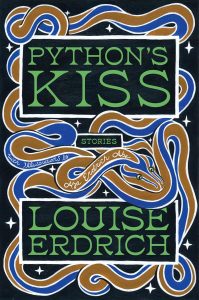
Louise Erdrich occupies one of those rare and coveted positions among contemporary authors: like Ann Patchett, Colson Whitehead, Jonathan Franzen, the late Hilary Mantel, and others, she is both a literary lion and a commercial success.
In its opening stories, her new collection, Python’s Kiss, treads the precarious path between those two pillars of achievement in fiction quite ably. The title story focuses on the narrator’s relationship with animals—an out-of-control guard dog named Nero, his love interest, Mitts, and an escaped python—and how those relationships parallel that of their human owners. There’s enough action to keep a casual reader engaged and enough reflection, not to mention confident and precise prose, for the literary reader.
The characters are often Native American, and the Upper Midwest is crucial as a setting. Minneapolis is the Big City, welcoming characters from the Dakotas and elsewhere, and sometimes ejecting them back to their rural lives. Erdrich is especially good at meeting the short story’s demands for quickly but richly sketched protagonists and a clear and immediate trouble for them to confront. There’s the eccentric aunt explaining to her niece why she’s held onto all four of her wedding dresses, and the bus driver in the great blizzard of 1923 who somehow manages to get his young charges safely to the schoolhouse, and the unlikely outlaw disappointed in life and love.
Then, about a third of the way through the book, just when you think you have Erdrich’s style and subject matter figured out, we are presented with two related science fiction stories: one rather long, and the other fairly short. The opening sentence of “Domain” provides an accurate summary of the story’s world: “Seven corporations control the afterlife, and many people spend their lives amassing the money to upload into the best.” The narrator’s preferred virtual afterlife, in which her mind will live forever, is Asphodel—the hippest of the bunch. The following story, “Asphodel,” is set in that domain, although with different characters, and offers a nice twist at the end.
I have to admit, at that point I put the book down for several days, not sure if I was ready for the next curveball. What was next? Gothic horror? Romantasy?
Thankfully, Erdrich returns to the more or less real world, although troubles aplenty await her characters. Toward the end of “Borsalino,” the narrator even seems to shift into autobiographical mode, as she discusses the suicide of her husband following charges she’d brough against him that “he couldn’t face.” Years later, as she is cleaning out what remains of his possessions from her garage, she writes: “I wore disposable gloves, as I was determined not to handle these things. Over time, I felt that I’d been cleansed, strengthened. I’d shed the layers of my skin that he’d touched, much like the snake” in the hatband of the Borsalino hat, which is the symbolic center of the story.
There is a story about two teenage girls playing a decidedly unsettling game called Assassin; and one about a man who reunites, unhappily, with the wife he divorced some time ago—everyone in her family snores so loudly he refers to their home as “a metalworking shop”; and there’s a rather endearing one about a teenage girl who is befriended by an elderly man.
However, Erdrich’s most significant achievement in the book is “December 26.” To a person, the characters are sympathetic, but the narrator, the family’s matriarch, has a son who’s in a great deal of trouble—exotic animals, drug smuggling, money owed to the mob—and it’s up to her to help extricate him. It turns out that Erdrich writes noir with a flourish, and of all the stories in Python’s Kiss, “December 26” feels the most like one that was cut short, that could have easily become a novel.
The book is elegantly designed, with each story prefaced by a drawing by Erdrich’s daughter, Aza Erdrich Abe. At first, I thought the drawings, which resemble the panels of a graphic novel, might give too much of the plot away, but no: they are too enigmatic. You only realize how the images fit together after reading the story.
Erdrich is primarily a novelist: Python’s Kiss is only her second collection of stories. I’d hate to have missed out on any of her novels, but one only hopes she will find more time to devote to this “lesser” art form. After all, as Julio Cortázar once wrote: “The novel wins by points, the short story by knockout.”