
MCD
Review by George Yatchisin
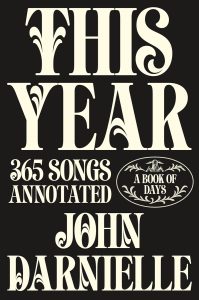
If the claim “songs are poetry” drives you batty, John Darnielle’s This Year: 365 Songs Annotated: A Book of Days will give you fits. Darnielle fruitfully teases the artful line from song to poem in many of this book’s entries, even if “what poetry’s good at,” as he puts it, “dense economies of rhythm, sound, and meaning” certainly describes the majority of his lyrics. But there’s another level, too: can a written version of the heard capture a song? For he writes, “The page is not the song; it’s an echo of the song, or a wobbly mirror of it, or a clarification of its position.” (Note his love of the clause building on the clause that begins with the book’s double-coloned title.)
First, though, I’m sure I’ve already lost some of you. And want to lose you more, for I can’t help but point out this lover of the direct address in lyrics early in his book asserts: “If I have the choice between rhyming ‘you’ or ‘me,’ though, I mean that’s not really even a choice, the second person is the preferred person when possible.”
Sorry, here’s the background you need to know. John Darnielle is the leader of, and often all of, The Mountain Goats, a musical concern since 1991. Hyper-literate, emotionally taut and often distraught, the vast catalog of songs—at first recorded super lo-fi on a Panasonic RX-FT500 boombox—have earned Darnielle a rabid fan base. Go find the YouTube of a gobsmacked-by-glory Stephen Colbert joining the band on a performance of “This Year”—the song called out in this book’s title—to see who likes him and how. Then consider Colbert insisted on doing this song, and not one from the then-current Mountain Goats album In League with Dragons. Even Tolkien geek Colbert passed on the songs inspired by D&D for an older cut.
I also want to apologize that I’m doing something annoying and arch in this essay, quoting more from Darnielle’s commentaries than from the song lyrics themselves. That’s because wrenching a line or couplet out from its home often seems a violation of a Mountain Goats song. Each one works as a world—they build, refer, offer, glance, chart dependencies. As he puts it: “The details of everything around something big are, for me, the places wherein the poignancy of a given scene can be most deeply sensed.”
But to be sure I get lyrics in, it’s convenient that even Darnielle’s songs also offer commentary on his process. Take the start of the unrecorded but oft played live “You Were Cool:”
This is a song with the same four chords I use most of the time

when I've got something on my mind,

and I don't want to squander the moment

trying to come up with a better way to say what I want to say.
Of course a Book of Days by its genre is meant to be piecemeal, but that doesn’t mean Darnielle hasn’t woven a series of throughlines into these 500+ pages. Anyone who has followed his career knows that’s true of his music, too, from the recurring Alpha Couple whose fierce love-hate culminates in Tallahassee’s “No Children”—as witnessed by the frenzied singalong at any of his concerts when he gets to the lines “I hope you die/I hope we both die”—to anti-hero Jenny on her Kawasaki roaring through songs for several decades. But in this book he’s good at returning to themes, such as cherishing both high and low culture, so you’re just as likely run into a Greek allusion as a luchador. Or his ever-questioning Catholicism, rich in faith and rooted in the literature—heck all the tracks on The Life of the World to Come are named after Biblical verses. (Robert Christgau—a fan—in his review of that album insists you do get more out of the songs if you peruse the scripture first. Take that for all the wonderful nerd levels possible.) Or hyper-focusing on writing choices more keenly than anyone since E.B. White; for instance, he admits to much idle musing about the quotation marks on the cover of David Bowie’s “Heroes.” (That he gets to that observation considering his lyrics for “Michael Meyers Resplendent” is another dagger to the heart of every sort of art.)
Yes, he’s a writer’s writer. One way to read the book—there are so many ways—is as a secret syllabus, pointing us to his wide wealth of influences, from Aeschylus to Arnold, from Berryman to Białoszewski, from Cicero to Celan, from Dickinson to Dubie. Whole mini-lessons hide, as when he lauds Joan Didion, saying, “whose elliptical approach to narrative is something of a lodestar to me,” just a few pages before claiming, “I’m a little mystical about sentences.” Who of a certain age hasn’t knelt at the altar of Didon’s prose, watching her wind and wend her way down a page, so often putting that finality of the period yet even further off? Better yet, between Darnielle’s two observations, he offers us this 105-word aria proving how deep Didion’s lessons landed:
Not sure if a generality like “most of the early Mountain Goats songs are really about sex” is useful, but still one notes that the imagery seems most vivid, and the tone most urgent, when there’s two people whose senses seem keenly attuned to the physical particularities of their surroundings, but whose focus narrows, as the song progresses towards its climax, to one another—together, away from the world and together in the ebbing glow of sunset, which, unless somebody turns a light on, and why would they do that, probably leads to a warm and dark room, possibly with the window open, but possibly not.
Don’t worry that This Year is in the slightest academic. He pronounces, “I do not do writing seminars, but if I did, there would be a TV in the classroom, and we would feast on second-string genre titles.” There will be blood, a whole album called Bleed Out. There will be morals, if often found under the fingernails of the immoral desperately clinging to something. There will be mercy, if often such a quick peek you could talk yourself out of it happening. Discussing a lyric about when professional wrestlers turn heel—he has two such songs—he writes, “You can ask anybody who has seen night fall even twice in their life about what luck you might expect to have opposing the darkness.” Now that’s some complicated noir.
Mountain Goats is a nom de plume like Lemony Snicket or Mark Twain or Mother Goose or Miss Manners or Matthew, Mark, Luke and probably John, letting Darnielle lurk in his shadowy characters that are perhaps, at times, informed by some of his own life. Teasingly he suggests, “This isn’t a memoir unless it is.” More revealingly he also says, “Storytelling is self-expression no matter what stories you tell.” (Yes, he’s written three fine novels, now, too.) Still, through his career and this collection of lyrics, the notion of the unreliable narrator gets blown out of the water—the book’s title even fibs, for we get a song and commentary for Leap Day, too. What is a story, after all? For he also writes, “‘Both are true’ is a mast to which I will still be happily tied on the day the ship finally goes down.”
For while some folks over-value the lo-fi “authenticity” of the earliest Mountain Goats songs—and sure, you can stack up “The Best Ever Death Metal Band in Denton” against anybody’s acme—but that Panasonic boombox, if you ask me, was the second member of the band in the early days, plus the crucial original audience. See? Something got made. That word is of import for Darnielle, as it keys his preface: “To make a book rather than write one is to assemble something whose external form masks its more flexible potential.”
Now go flex that potential.