
Doubleday
Review by David Starkey
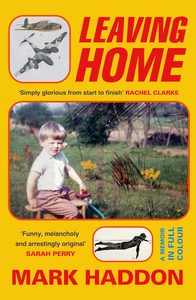
I have to admit that the only other book by Mark Haddon I’ve read is his wildly popularly 2003 novel The Curious Incident of the Dog in the Night-Time, with its winning teenage narrator, Christopher John Francis Boone, a person with autism and an unforgettable literary style. I also saw the equally successful play, and remember thinking that I ought to check out more of this author’s work, including his follow-up novel, A Spot of Bother.
I didn’t, though, so when I picked up Haddon’s Leaving Home: A Memoir in Full Color, I wasn’t sure what to expect. Happily, I was drawn in immediately, not least by the color pictures which appear on almost every page of the book. There are snapshots from family and friends, drawings by his architect father, cigarette cards collected by his paternal grandfather, a drone photo, a map of the solar system from a Weetabix cereal promotion, an album cover, book covers, Bauhaus posters, and lots and lots of art created by Haddon himself who, before he became a successful adult author, was well-known as an author and gifted illustrator of books for children and young adults. Among the illustrations created by Haddon for Leaving Home are everything from computer-generated comics to moving watercolors and line drawings of his parents during their final years.
If the prose weren’t so good, it would be a risky gambit to overload a memoir with so many images. Fortunately, Haddon’s writing is clear, precise, witty, ironic, self-deprecating and always extremely readable. The less than 200-page memoir is divided into 87 chapters, so things move along a fast clip.
We learn about Haddon’s unsympathetic parents, a cold mother and a distant father, who are surely at least partially responsible for his numerous childhood phobias, which include sharks, being flushed down a toilet, aliens, and train tunnels. Indeed, as the author grows up, just about everything makes him worried. He recalls saying in an interview that he’d “been an anxious and depressed child. It seemed an unremarkable comment. I knew many people who could say the same.” Haddon’s honesty, his refusal to look away from the unpleasant elements of his life, and those lives of those around him, is particularly appealing, especially since he nearly always manages to infuse a sense of humor into the most dire circumstances. Not many people could get a laugh out of open heart surgery, a battle with long Covid, and the near-death of their wife from a catastrophic bicycle accident.
Haddon was born just a couple of months after me in 1962, and I sometimes felt the kinship of near contemporaries who both had one younger sister and grew up in unimportant provincial towns at a certain historical period. At the same time, when Haddon immerses himself in the details of British life of the era, I couldn’t help but feel a great divide open up between Northampton and Sacramento. His childhood memories are triggered by “Hillman Imps, Ford Capris…a tin of Watney’s Party Seven, sheets of Letraset, chocolate cigarettes.” I remember candy cigarettes, yes but the rest of it? Before I looked it up, I couldn’t have told you for a million dollars what a Hillman Imp was (turns out, it’s a small and very ugly car).
Still, I suspect my feeling that a place or mood or incident described in Haddon’s memoir relates to me specifically is one that readers of quite different backgrounds will share. When he writes that “There are endless routes to the weird zone” he is talking about fiction that steps “out of time or into a parallel world,” but the weird zone could also be described as the location where reader and writer meet long enough to get to know one another in strangely intimate ways: Leaving Home is such a place.