
Doubleday
Review by Walter Cummins
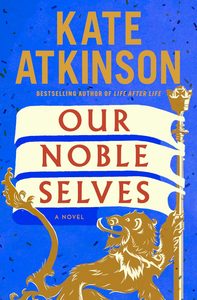
Like the characters and happenings in Kate Atkinson’s latest novel, its title—Our Noble Selves, a phrase of stoicism used by British soldiers—is ironic. It serves as an encompassing commentary on the people and events involved in creating the 1951 Festival of Britain, an actual event meant to celebrate the promise of the country’s pending future after it survived the sufferings of World War Two. For all the urgent preparation, the result turns out to be a conglomeration of jerry-built displays, the people responsible for them detached from the purpose.
Harry Flynn, notified of the project two years in advance by a former boss from the time he was a journalist, falls with a group of odd characters hired to plan and furnish—usually behind schedule—the exhibits whose floorplan designs are inserted throughout the novel’s pages. Even the additional characters not directly employed have some relationship with the event. How is often among the novel’s revelations.
Flynn is burnt out, there because he doesn’t know what else to do, feigning a minimal engagement with his job. When asked if he had served in the war, he feels compelled say no because he wasn’t in uniform. But captured as a reporter in Singapore to become a POW forced to work on the Burma Railway, he suffers as extremely as any actual soldier or sailor, so desperate in his starvation that he once ate a live mouse, He tells none of this to his new associates, but when some hear where he had been during the war, they understand all that he had endured.
While noting the awfulness of what Harry and several of the others suffered, Atkinson deliberately does not emphasize the horrors, allowing them to lurk as an underbelly to the present action, serving as an implicit comparison to the novel’s comedy, which makes even the bloody mangling of the accumulating deaths laughable, another set of ironies. These post-war victims and their corpses are almost cartoonish.
The action focuses on Flynn and the detachment through which he confronts the day. Harry “vowed to stop merely plodding and to live his life lightly—to skim the surface, like a water boatman, and have no truck with the depths below.”
Still, people seek him out, burdening his passivity to the point where he finds himself agreeing to do what is asked of him, including breaking into a flat to steal racy photographs. Why he is asked to do such things turns out to be from a complexity of motives tied to the plot’s ever-changing unknowns.
Women are attracted to Flynn. Early on he allows himself to marry the busty Ivy Shears in a disastrous marriage that he soon flees but that eventually has a positive result for him that has nothing to do with Ivy. His seeming availability appears to be the reason the French Festival employee, Delphine Dubois, invites him to meet her for drink, in what turns out to be an awkward encounter. He sees her off in a taxi, and there starts the novel’s plot, with Delphine disappearing and Flynn called her boyfriend and possible murderer by just about everyone. A pair of policemen keep turning up to harass him.
The Festival begins, some displays never opening, but the crowds love it, even though once shuttered it—like much that had involved the characters—is quickly forgotten: “The Festival proved itself to be astonishingly ephemeral. Everything was consigned to the scrapheap or eagerly auctioned off on site. The Pavilions were torn down ruthlessly. Every last brick removed from every last building.”
What Atkinson has written can stand as a British farce, a genre incorporating a form of chaos with exaggerated situations, mistaken identities, and rapid action. It also plays with social norms, as Atkinson does with the role of the class structure.
The aspect that Atkinson emphasizes in this novel is an intricate plot filled with misunderstandings. Her version is set on the streets of a city, London, with the characters constantly bumping into one another and then often disappearing, some seeking the ones they can’t find, and, behind it all, confusions and surprise disclosures about identities and behaviors.
This constant shifting animates the story with most of its characters revealing or being exposed regarding their actual functions and their identities, in some cases even their real names. Such disguises and exposures are also the stuff of grim mysteries and espionage novels that Our Noble Selves plays on as the basis of its comedy. But the people in this story are eccentrics, often mistaken, often blundering. Even though their mysteries are intriguing, they can’t be taken seriously. Still. they are engaging and very amusing, as overblown as the Festival itself.