
Serving House
Review by Walter Cummins
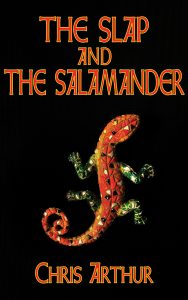
I had my first contact with Chris Arthur several decades ago when he submitted an essay to a quarterly I was editing. We, the staff, were immediately impressed by the originality of his approach and the richness of his ability to see relationships that no others could imagine. Since then I’ve read and written about several of his essay collections, and I’m still contemplating his unique approach, how he does it.
His starting point is usually a specific object or event. For there, he opens up to a wide range of time and space and history. A Chris Arthur essay takes readers to deep discoveries and insights. After reading one of his collections, you see all that is around you differently. Every object or happening, simple as it may seem, is a multiplicity of facts, ideas, insights, and speculations.
Arthur possesses an exceptional ability to unify and make his findings vital by exploring their many possibilities of meaning and significance. Any object he writes about immediately comes to life. He perceives the infinite possibilities in the seeming singularity of an individual bird or a word like “admonition” or stairways that lead nowhere. All around us is alive with a growth of expanding linkages, as he cites Montaigne’s assertion that all things on earth are in “constant motion.”
The mind does not follow simple stepping-stone images one by one, or the words that identify them and anchor them to the page. Rather it is in and of the water of experience—our sentience is more akin to currents and temperatures in liquid than to anything that has the fixity of what’s solid.
He marvels at the wonders each day offers. “What seems commonplace at first reveals itself as extraordinary.” That open vision is illustrated in the essay “Repeated Passages” that begins with the mundane of Arthur’s daily thirteen-mile bus commute where he challenges himself to ponder the mysteries all that’s around him, starting with the workings in the heads of his fellow passengers and, arising from his memory of the discovery of a preserved of a five-thousand year old body, imagining the bus being preserved for a similar time span into the future, then wondering what a 72st century anthropologist called Aneela would make of those beings preserved for detailed examination. The commonplace of a daily commute becomes the source of many possible wonders.
In his essay “Zen and the Art of Catching Birds in Words,” Arthur explains what his goal had been when writing a previous work about a pigeon: “In this particular piece, I was looking for a way of conveying on the page the incredible cargo carried by something that at first sight seem straight forward, even uninteresting […] Unusually, because I’m, better at posing questions than answering them, the essay concluded that ‘I could exhaust my word-store completely without even catching a fraction of what’s out there.’” Beyond that, the word-store takes us to places we couldn’t predict: “… as we voyage on the life-rafts of language offers it is easy to drift off course and end up in unexpected—but not necessary unwelcome—destinations.”
While a graduate student of religion, he found a much closer sense of the numinous experience attributed to religion in watching sparrowhawks in a small wood than in the many structures meant for humans as places of worship. Rather than theoretical abstractions about the religious apprehension he cites the words of another writer on seabirds; they “manifest a beauty on the margins of understanding.”
As much as Arthur celebrates the surprising value of living things, as with the wonders of noisy starlings in his present yard and in his memories of them in his youth, he also laments the threats of disappearing species. In an essay that starts with the images of a past bombardment of krakens, he contrasts that event with their present rarity and their possible immanent vanishing. As a student of the wonders of the natural world, he both accesses the wonders, even writing an unsent letter to fictitious educators calling for grounding students in the reality around them, and also condemns the destructiveness of contemporary civilization. We humans all share habitation of “the sorely threatened house of Planet Earth” as we experience “the massive unravelling of life that we’re witnessing.”
Although I’m relying on the memory of previous reading, I consider this the most autobiographical of Arthur’s collections. That’s not to forget that most of his many previous essays include or are even based on his personal involvement in exploring the meanings and connections arising from the event or object that is his starting point. But the Chris Arthur in those essays is primarily an exploring intelligence.
That aspect continues in The Slap and the Salamander, but throughout and as the basis of a number of the essays, Arthur the man behind Arthur the mind is revealed. He writes about a daughter’s reading, a brother who never received a lost birthday gift, a mother-in-law’s marginal notations, about his moves from Northern Ireland to Scotland and Wales and back to Scotland, along with references to his teachers, his parents, and his wife. All of this personal information solidifies a theme underlying his approach to the world around us. We are deeply part of it as individual beings, distinct and meaningful, just like each bird in his frequent considerations of aviary existence.