
Crown
Review by Walter Cummins
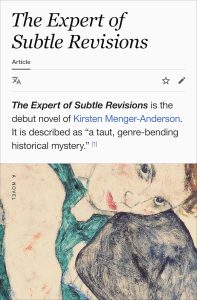
The Expert of Subtle Revisions opens with a conundrum in a section titled “Mira,” set in Half Moon Bay, California, in 2016: “As far as official records go, I do not exist.” She goes on to reveal that she has no record of her life, no bank records, social security number, birth certificate, passport—no official document that would attest to her existence. Only two people are her friends, and one of those not close. “My only family is my dad, who isn’t my biological father.” That man homeschooled her. The obvious question raised by this paragraph is how a human being could be on earth so anonymously, without a trace of her presence and identity, without a clue to her origin.
The day she introduces herself is her birthday, a lonely event because she does not receive the expected call from the man she thinks of as dad, the one person she trusts completely. He is gone and the boat he lives on missing. Hase, the narrator, wonders why her mother had abandoned her, with her only memory a necklace she possesses. To make the day even worse, Hase discovers the apartment she shares has been broken into, her laptop stolen, taking all that she has recorded. By the time the day is over, she is more isolated than ever.
By the third chapter, still told by Hase, she is introduced to two other figures, the living Dr. Peter Fury and a man from the past named Josef Zedlacher, a shelf of whose books, including a memoir, is stored in Fury’s office. Fury has been seeking Hase’s father’s papers, referring to him as Herr Professor. Zedlacher, at best, is designated as fringe but more commonly as crazy. His Institute is called “controversial” and “cultlike”: “Zedlacher’s claim that we can travel forward and back through time—and already have—absurd.”
Hase first heard Zedlacher’s name in a room with her father, and he, usually a placid man, snapped never to speak of him. Hase learns another name, Haskell Gaul, and becomes aware of the existence of a young man who claimed to be Gaul. Zedlacher had believed Gaul “arrived in Vienna in 1933 from an unknown point in the future.” He also believed a magic music box could make a person disappear in time.
That reference to Vienna in 1933 introduces the setting for most of the novel’s following chapters. Some later chapters do return to Hase, with the Vienna chapters titled “Anton” and “Joseph.” Other characters join through their interaction with those two, important figures like Professor Adler, Sophia Popovic, Professor Engelhardt, and others in his Circle. Several of these people are identified by various names in the novel, a deliberate strategy to see them in both first name closeness and also in the distancing of a more formal designation.
The Vienna world focuses on the events associated with the city’s university, with people writing doctoral theses, competing for teaching positions, interacting with deep and at times violent emotions, including a gunshot death. This is also a time of increasing Nazi power and antisemitic attacks, including the firing and expatriation of faculty.
Several expatriates relocate to Hase’s home area in California, where events depicted in the novel’s final chapters reveal the connection of Hase’s world to that in Vienna. Mysteries are resolved through the interactions of identities and relationships. Ultimately, Hase finds a place and a history of self.
A character called Manifold, who was also Haskell Gaul, takes on greater importance in the final chapters because he has the knowledge to explain major unknowns. He describes the power of the music box: “Once you wind the music box, you become part of a new song, and that, it turns out, changes everything.”
When Hase and her dad were active together, one of their major amusements was creating fictitious identities that enable them to contribute entries to Wikipedia, delete others, and revise the information in still others. This creation and manipulation of supposed reality, while a seeming hobby, is symptomatic of what is happening to the people of the novel, emulating the power of the music box.
Menger-Anderson’s success for readers, beyond her strengths in creating people and realities, depends on winning over their credulity to accept varying identities, the musical essence of human lives, and the doubling patterns of human existence. The richness of her imagination contributes to our acceptance her sometimes wild premises.