
Beacon Press
Review by Brian Tanguay
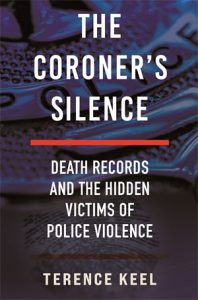
When I think of people who died while in state custody the first name that comes to mind is Sandra Bland, the 28-year-old Black woman found hanged in a cell in Waller County, Texas, in 2015. The next person is Jeffrey Epstein, the convicted sex offender and one time friend of Donald Trump who was found in his cell in the Metropolitan Correctional Center in New York City in 2019. Law enforcement and medical officials determined that the cause of death in both cases was suicide.
The Equal Justice Initiative, founded by Bryan Stevenson in Montgomery, Alabama in 1989, has done considerable work to expose the lethal conditions found in some Alabama prisons, but unless a death in custody involves a well-known person, like Jeffrey Epstein, or the case sparks media interest as Sandra Bland’s death did, people don’t spend much time thinking about what happens inside jails and prison facilities. Out of sight, out of mind is the rule of thumb. In The Coroner’s Silence, Terence Keel, a professor of biology and African American studies at UCLA, and the founding director of the BioCritical Studies Lab, seeks to bring deaths in law enforcement custody out from behind the veil. One shocking fact noted by Keel is that no comprehensive list of persons killed by law enforcement exists for any given year in our nation’s history.
This book is more powerful than its slender size indicates. In less than 200 pages Keel connects how the neglect and indifference that are features of American society spill over into the carceral system. Keel and his research team analyzed hundreds of cases, reading the reports of coroners and medical examiners, which are frequently written in language so bland and neutral that it seems the deceased were responsible for their own deaths. More a result of design than accident, coroners and medical examiners are reluctant to attribute deaths in custody to law enforcement. Keel provides history and context to explain why. He also presents data to show that the problem isn’t confined to black and brown people. Systems and routine practices are contributing factors, but so are mindset and common assumptions. “If we are going to avoid a future where in-custody deaths are simply how the law operates in America,” writes Keel, “it will require a new ethical sensibility toward people on the other side of it.”
At the moment a new ethical sensibility is nowhere in sight. Masked federal agents have killed a number of people in the past year and a half, and many more have died in immigration detention facilities run by corporations. Recent reporting by The Intercept revealed that Immigration and Customs Enforcement continued to contract with the GEO Group — the largest private prison company in the country — after determining that the company falsified death records. As Keel explains, the myth of American freedom has turned us into terrible caretakers. “This is the first and most important thing you have to understand about dying in custody: the violent actions of law enforcement and the inadequacies of our death investigation system are not defects in state governance. Instead, they complete a process of neglect and indifference that have been steady features of American life.”
That’s a damning assessment. We’re not socialized to identify with people in state custody, held in deplorable conditions, in solitary confinement, beaten and abused by guards. As this important and timely work shows, such people don’t even deserve to have their deaths properly or accurately recorded, let alone attributed to actual causes. All too often, these are bodies hidden from the public record.