
Pantheon
Review by Walter Cummins
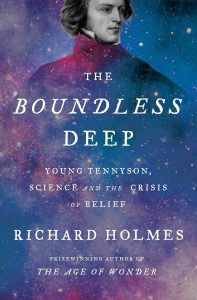
The image of Alfred Tennyson I’ve carried for decades goes back to the childhood card game of Authors that depicts him with a stately continence sharpened by a jutting black beard. He’s formidable, his aura superior. Holmes opens his biography of the youthful Tennyson by describing the similar formality of the imposing Tennyson statue at Trinty College Cambridge, sharing the honor with other Trinity greats, including Isaac Newton, Francis Bacon, and Thomas Babington Macaulay. Holmes doesn’t want to chip away at that statue but rather reveal its inner youthful core of the man—tall, handsome, and talented but unformed, emerging from a disturbed family of addicted or insane male siblings and four unusual sisters struggling under a violent alcoholic clergyman father. Alfred was certainly statuesque, but would he end up a block of unformed stone like his equally promising brothers?
He was youngest of three equally regarded Tennyson brothers at Cambridge, all bright, handsome, and talented, in fact Alfred regarded by some as less promising than his elders who also wrote poetry. Yet Alfred wrote one of his major poems, “The Kraken,” at twenty, revealing both his talent, his interest in geological forces, and the haunting creature that embodied his anxieties.
While Holmes focuses on Tennyson of the 1830s and 1840s, he can’t tell his story without exploring his involvement with the Victorian intellectual upheaval. Tennyson was fascinated by new scientific perspectives, following the latest findings as soon as books and articles were published. He was especially taken with Charles Lyell’s deep studies of geology and the discovery of fossils and a timeline of the planet’s development that did much to question fundamental religious assumptions. The impact of these discoveries is reflected in Tennyson’s poetry and led to the crisis in belief he shared with so many contemporaries. He was especially taken by the cycles of destruction and renewal that informed the struggles he confronted in In Memoriam, Maud, and Idylls of the King.
Tennyson was only one of the eventual major figures at Cambridge at the same time, young men just beginning to realize their potential. Charles Darwin was at Christ College, although there is no evidence that he and Tennyson even met as students or later in life. Yet evolution became significant in Tennyson’s thinking and the issues of his poetry.
One of Tennyson’s best and most important Cambridge friends was Edward FitzGerald, who became the translator of The Rubáiyát of Omar Khayyám and in their on and off relationship served as Tennyson’s harshest critic. FitzGerald was also a friend of the novelist William Makepeace Thackeray, the two of them partying in Paris as undergraduates. That connection led to a friendship between Thackeray and Tennyson. Others who came to play significant roles in Tennyson’s life were Thomas Carlyle, the Brownings, and the Pre-Raphaelites.
Tennyson’s deepest friend at college was Arthur Hallam, who at twenty wrote a glowing review of Tennyson’s first poetry collection, travelled on European adventures with him, and fell in love with his sister Emily. Hallam was also regarded as one more very promising Cambridge student. His sudden death at twenty-two in Vienna from a stroke while travelling with his father devastated many friends, but perhaps Tennyson most of all. He did not write immediate poems of grief but took years to compile those collected in In Memoriam A.H.H., published in 1850, almost twenty years after Hallam’s death
For all of Tennyson’s early poetic successes and successes, Holmes reveals him as an often troubled young man suffering periods of depression, fearing planetary upheaval, concerned about supporting himself, disappointed in romances, and worried that he would inherit the family’s mental illness tendencies. Yet despite his seeming withdrawals, he was always writing poetry that he kept private and would not let go, constantly revising.
1850 became a transformative year for Tennyson. He finally consented to publishing In Memoriam with a last-minute prologue that acknowledged God and perhaps convinced the religious Emily Sellwood to marry him after years of pursuit.. He opened up to Emily, revealing his struggles with fears of depression and “weird seizures.” The devastating event of that time was the stillborn death of his unnamed first son. It shook him, but Emily’s faith brought them closer and convinced him to believe in an afterlife. Two later sons survived.
With the death of William Wordworth in April of 1950, Tennyson was named poet laureate at age forty-one, reluctantly accepting. It’s as if Tennyson’s life split in half in that year. He lived another forty years, now a recognized success, with the prestige of being an official poet writing patriotic verse, wealthy and revered, no longer the insecure young man seeking an outlet for his immense talent. He earned a place in the Authors deck, now dignified and in 1884 elevated to the peerage as Arthur, Lord Tennyson.
Richard Holmes is the author of twenty previous books on the Romantics and Victorians, several of which received awards. The Boundless Deep was shortlisted for the 2025 Baillie Gifford Prize for Non-Fiction. He captures the complex vicissitudes of Tennyson’s youth, illustrated by frequent excerpts from the poetry, placing that life in the full context of the shattering discoveries that led to an upheaval of thought in the Victorian age.