
Penguin
Review by Walter Cummins
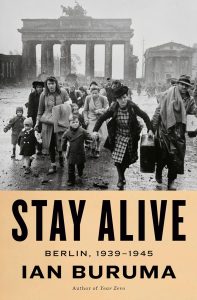
While I was reading Stay Alive, bombs—many more powerful than those of World War II, others delivered by drones—were falling on a number of cities—Kyiv, Teheran, Beirut, Tel Aviv, as well as towns and villages. It’s happened before, again and again. Buruma tells how such devastation affected Berlin from 1939 to 1945, the years of the second world war, where allied bombing turned the initial celebration of Nazi victories into massive suffering through the destruction of property and lives, ultimately with starving people desperate for survival crammed into any available underground space, where they often had to step over body after body. Thousands in today’s bombarded cities are seeking similar shelters. What else replicates enduring war in today’s cities with what happened in the nineteen forties? Buruma’s book makes vivid daily life in Berlin at that time and how it varied from year to year, mirroring Nazi fortunes on the battlefield. His title, “Stay Alive,” is certainly pertinent, both then and now.
Usually, reports about what took place during wars are compilations of facts and summations, information like statistics of casualties and tonnage of explosives. Buruma, instead, humanizes the consequences and tells his story through what happened to real people who are named and individualized, each page a collection of vignettes of their activities, some told in a paragraph, others in a few sentences.
Buruma’s inspiration for the book came for his father’s—Leos’s—memories of living in Berlin in the mid forties as a young Dutch student laborer with time after his many working hours to roam the city and meet with people and attend events. He witnessed much and did debate the morality of his job helping the Nazis, writing to an elder sister: “I understand that we might not be welcomed when we come back. I wouldn’t hold that against anyone. But it is surely wrong for those who were fortunate enough to escape our fate to blame us for being here.”
With Leo’s memories as a starting point, Buruma did extensive research in material compiled by those who lived through the times and kept written records in diaries and eventual books, as well as survivors he was able to interview personally. Many of these people are woven into the text of the book, returning again and again throughout the chapters, depicting the declines in life as the city turned into a different place.
One prominent source is Ruth Andreas-Friedrich, an anti-Nazi journalist, with her partner, Leo Borchard, an orchestra conductor. She was present when most of the city’s residents were celebrating initial Nazi victories in their quick occupation of neighboring countries. She calls the mood “ecstatic triumphalism,” with church bells ringing out all over the city and “Every window, every gable, every tower is submerged in a sea of swastika flags.”
Many of Buruma’s sources, like Ruth Andreas-Friedrich, did not share this celebratory mood. When asked why they did not flee the country, they explained that they considered themselves German patriots consumed by fears for the fate of their country, enduring when victory turned to defeat and simple survival became the goal of those who had once danced in the streets.
Sabine Alenfeld, with a Jewish husband, wrote to her sister: “Our lives are turning more and more into a race, a race against…well, what. A race against death, of course, but also against the possibility of living.”
One Nazi figure whose presence runs though the book is Joseph Goebbels, the Reich Minister of Propaganda, whose actions reveal a conviction for the need of entertainment during times of anxiety, both as a diversion and as a method of building support for the goals of the regime. He spent very large sums to produce movies with the finest actors to amuse large audiences who packed into theaters, even when those theaters were severely bomb damaged. One successful movie was the 1940 antisemitic Jew Süss, which fictionalizes the life of a Jewish financier as a tale of seduction, corruption, and treason, but most movies were escapist musicals and love stories.
Even as bombs fell and left streets of rubble, people in Berlin—as in many besieged cities—had a need for escape in dining, dancing, attending concerts, and viewing fictional realities far from the one they endured every day. Those escapes continued through most of the war, until the last years of the Nazi regime when, for the majority who were hungry and homeless, their minds were dominated by the grasping hunt for food and safety.
The war in its final weeks, Hitler and Goebbels both suicides, the city was overrun with Russian soldiers, many raping and looting. As Buruma reveals, “From people whose memories I tried to probe, I kept hearing the same thing: “Life was much harder after the war,” that is “when things got really rough.”
Yet in the book’s “Aftermath” Buruma’s “Stay Alive” takes on another meaning. He reports what happened to people cited throughout previous chapters, and much of it is unhappy, But Berlin has been reborn, the architecture replaced, the people flourishing, the city even more of a world cultural capital than it was in 1939. Buruma and Leo were there in 1989 when the wall between east and west went down and people rejoiced in a “partying melee.” Since that time Buruma says has come to love Berlin, this book a “love letter” to the city, which he admires most for “the way it has dealt with its past, the way the scars of its worst crimes are openly on display.” That reborn city lives again. Today’s cities are an open question.