
Helvitiq
Review by David Starkey
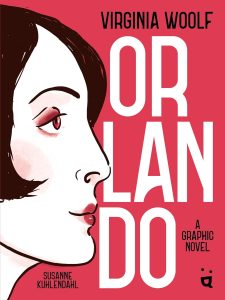
Virginia Woolf’s Orlando: A Biography, a novel about a male Elizabethan aristocrat who, at the age of 100, turns into a woman, has inspired a number of versions in other media, including Sally Potter’s film starring Tilda Swinton, along with a range of stage adaptations. It’s not surprising, therefore, that the book would also be the basis for a graphic novel. As Woolf scholar Anna Snaith notes in the introduction, “Susanne Kuhlendahl’s graphic adaptation…seems particularly apt given that Woolf often thought and worked across verbal and visual modes…. The original text of Orlando included images and photographs,” with a focus on Vita Sackville-West, Woolf’s lover and the model for the novel’s protagonist.
Orlando is a shortish book, but of course it’s much longer than the text to be found in a version taken up mostly by pictures. Kuhlendahl, who has also written a graphic novel version of Death in Venice, addresses this disparity by quoting judiciously and sparingly from the original. Occasionally, as in the pivotal moment after Orlando changes from a man to a woman, she quotes Woolf exactly: “Let biologists and psychologists determine. It is enough for us to state the simple fact; Orlando was a man till the age of thirty; when he became a woman and has remained so ever since.”
More often, though, Kuhlendahl must hit the highlights, which inevitably eliminates the texture of Woolf’s authorial voice. Toward the end of both books, for instance, the ageless Orlando, who has lived through the 300 years of English history, finds herself in the twentieth century. Kuhlendahl writes: “It was 1928. It was the present moment. And Orlando was terribly late.”
In Woolf’s original, in between second and third sentence of the graphic novel, which are direct quotes, we are offered this reflection: “No one need wonder that Orlando started, pressed her hand to her heart, and turned pale. For what more terrifying revelation can there be than that it is the present moment? That we survive the shock at all is only possible because the past shelters us on one side, the future on another.” That’s a nice bit of Woolfian writing, both serious—being intensely aware of oneself at any given time can, indeed, be “terrifying”—but of course it’s always the present moment, so there’s some gentle irony there as well.
If that’s the sort of observation that’s lost in the graphic novel, what’s gained is a great deal of fun. The two-page, full-color spread that depicts Orlando’s epiphany shows her rushing to get dressed, hurrying down a spiral staircase and out into the street where she hops into her motorcar, which she drives recklessly down a London street as hapless pedestrians jump out of her way.
The visual element must make up for the loss of language in a graphic novel, and, fortunately, Kuhlendahl has a light, sometimes whimsical touch with her pen and ink and watercolor illustrations. Among the highlights are a spread showing the ice melting on the Thames after the Great Frost of 1608, another depicting the passage of seasons and years, a wordless rainbow-colored rendition of a ball, and Orlando’s heady love affair with Marmaduke Bonthrop Shelmerdine. Kuhlendahl loves to draw, and every page is brimming with images.
Woolf herself appears frequently in the graphic novel version, commenting, as she does in the original, on her characters and their behavior. She looks amused more often than bemused, though at times she is also sad or angry. The roman à clef element of the novel is highlighted by the fact that Kuhlendahl’s drawings of Orlando as a woman look very much like photographs of Vita Sackville-West. Interestingly, while Orlando is mostly a sympathetic protagonist, Woolf apparently didn’t think much of Sackville-West’s literary efforts: Orlando’s poetry is mercilessly mocked throughout both books.
But what about the bastardization of a classic, some might worry. Do we really need an Orlando graphic novel? Actually, I think so. Rather than replacing the original, Kuhlendahl’s version is much more likely to motivate readers to take yet another turn through Woolf’s masterpiece.