
Bloomsbury
Review by Brian Tanguay
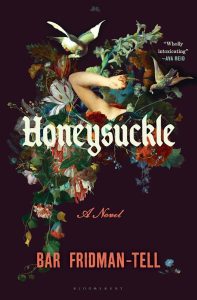
Honeysuckle is one of the strangest novels I’ve read in a long while, and by strange I mean in the sense of unsettling and rarely encountered. Before reading Bar Fridman-Tell’s grand debut, I’d never come across the word Blodeuwedd, a Welsh word for a mythological flower-faced goddess. Fridman-Tell takes the concept and conjures a world that contains both whimsy and abnormal desire. Although part of my questioning mind was resistant at first, it wasn’t long before the novel pulled me into its current.
Wynne and Rory are sister and brother, living in the country with only a housekeeper and a private tutor for adult supervision. Their parents are elsewhere and play no role in their lives. Wynne is the eldest by six years and takes responsibility for looking after her brother. With no one else for miles around to play with, Rory naturally looks to his sister for companionship and as his playmate. Wynne soon tires of being trailed by her little brother and decides to create a companion for him. Collecting leaves and flowers from every bush in the yard, Wynne weaves and weaves, and “before long a little girl lay in front of her, with skin the milky color of meadowsweet and slim limbs tapering into branch-thin wrists and ankles; hair the vibrant yellow of broom and a round, ruby-ripe strawberry of a mouth.” While weaving Wynne mutters a stream of words and then commands the flower girl to wake up. Daye is born.
Daye is a perfect playmate. She can run as fast as Rory, climb trees, and hunt down mushrooms; no matter what games Rory comes up with, she’s agreeable, compliant, which makes her even better than a sister. For the first time in his life Rory is in charge. While Daye cannot speak, she can communicate with gestures and facial expressions and the two develop a shorthand. Rory and the Blodeuwedd become inseparable. Everything is idyllic until the season begins to change and Daye starts falling apart, her skin flaking, her ankle stuck at an unusual angle, and then a finger falls off. Rory panics and runs to Wynne demanding she fix Daye. “She’s not a person,” Wynne says, “she’s a flower girl. That’s what flower girls do. They’re not meant to last.” Devastated, Rory will not relent, so using autumn leaves, apples, late harebells and yarrow, Wynne weaves Daye back to life. The crisis of seasonal transition is averted, but it’s only the first of many, and it’s here that the novel begins to take a darker turn.
It’s one thing for a boy of eight to have a female Blodeuwedd for a playmate, but what happens when the boy becomes a teenager and awakens to his sexual urges? For Rory the first challenge is to devise a way to protect Daye from falling to dust every season. Wynne is studying at a university in the city and suggests Rory use the library to research possible solutions. Discovering shelves full of books relevant to his quest to prolong Daye’s existence, Rory devotes himself to his research with an obsessive single-mindedness. As this goes on, month after month, the tension begins to build. Like Dr. Frankenstein and his monster, Rory’s all-consuming obsession with Daye feels dangerous. Though the work fulfills Rory and meeting students his own age expands his horizons, every trip to the city is time away from Daye who utterly depends on him; her dependency is as sad as his obsession.
Rory constantly professes his love for Daye, and encourages her to reciprocate, but when he figures out a way to give Daye breasts and genitals, the shape of a woman, even Wynne is mortified. “Oh my god,” says Wynne. “You didn’t. You built her genitals so you could sleep with her? You actually created your own sex doll? Did you tell her you were going to do it, or did she simply wake up one day with new organs? Rory!” One of Rory’s fellow students, a girl named Hanna, is even more blunt. But Rory cannot stop himself now, nor does he consider what’s best for Daye or what she wants; he’s blind, addled by the power of creation. He next decides to give Daye a voice by weaving a parrot’s syrinx into her neck without telling her. For Daye this proves to be a bridge too far as she knows Rory killed a parrot for its syrinx. Rory can’t understand why Daye isn’t thrilled, a sign of how far over the line he has strayed.
Honeysuckle can be read as a horror story or as a cautionary tale about power dynamics and the moral limits of knowledge. The novel presents an age-old human dilemma. Just because we can do something — taming the atom and building nuclear weapons, deploying AI widely — doesn’t mean we should, at least not without sober consideration of the potential unintended consequences. Rory isn’t an evil young man, but he is guilty of hubris, of believing he can outwit the elements, the basic laws of nature that govern the fate of every living thing; he refuses to recognize that nothing lasts forever.