
Rain Mountain
Review by Walter Cummins
Robert Clinton’s ekphrastic poem “Egon Schiele,” which finds words to describe how Schiele creates a painting, provides a visual equivalent to the way Clinton creates a poem. He begins with—
Account for his colors —: imagine in darkness

he cut houses and rooftops to pieces,

glued them into new canvas in the dark,

feeling best as he could for their places,

with angles of odd inadequacies and upside-

downness.[…]
Like Schiele’s paintings, Clinton’s poems evoke new realities by remaking the familiar in new linguistic settings, with an unexpected word or image that can be considered odd-angled. Consider the opening section of “Three for Trees,” in which he envisions tree-ness as no one else ever has—
Black roots inlaid where dirt has water,

water hard climbing cell walls with these

steel sugars and hand-wound hormones

up to green wrought leaves’ perimeters.

There are the decks where light will lie

while the leaf plush radiates its vapors.

Punish a tree: the leaves turn into rags,

and the sun lies all day in the dirt.
Under these lines lies a remaking of the way water nourishes a tree. This is a technical explanation: “Water nourishes a tree primarily through a process called transpiration, which involves the movement of water from the soil into the roots and upward through the tree to the leaves. Water is absorbed by the roots from the soil by osmosis and then travels through the xylem, a tissue composed of small hollow tubes, that extends from the roots to the leaves. This movement occurs because of a water potential gradient, where water moves from areas of higher potential (soil) to lower potential (air) and is facilitated by the cohesive properties of water molecules, which allow them to stick together in a continuous column.
Clinton reimagines these mechanistic steps as a emotional event with aspects of a struggle with the water “hard climbing” and the notion of “steel sugars” implying a counter weight, then adding potential threat—punishment—that will take life from the leaves.
Threat underlies many of the poems in the collection, an ominous menace hovering over people and objects, as this opening of “Final Analysis”: “You mustn’t speak; you mustn’t move. / You mustn’t startle when we take hold of you. / We’re here to map the faults, here to uncover / your track in life’s maze, now you’re out of it.
And this is the conclusion of “Bones Only”:
[…] Crows

make a black scratched song as they lift

from their palisades and slate granite ledges.

And the concluding stanza of the collection’s penultimate poem, “Night Sailing”:

We’d never come to any place, any rock

or wreck to ruin us—my hollow, half-egg

in the sea, safe and sightless, night sailing

edges of the earth as black as gallows,

boat black from stern to bow, black as tar.
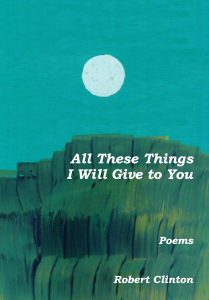
The collection’s title is found in the conclusion of “These Wastes” with one crucial additional line. The speaker walks a path with a mouse, a crow, a snake, and a wolf through a landscape of folks running mad, rats in rags, green fields unended, when he is suddenly lifted to a stone seat on the highest mountain next to a woman where his creatures—mouse, crow, snake, and wolf—migrate to her, and where: “The afflicted world brilliant in her eyes, / She said, All these things I will give to you / If you will fall down and worship me.”
Robert Clinton has given his readers a challenging body of poems imagined in darkness and glued to a new canvas.