
Bloomsbury
Review by Brian Tanguay
The late Daniel Ellsberg is perhaps the most famous whistle-blower in American history. When he copied and leaked the Pentagon Papers in 1971 — a damning indictment of the conduct of the war in Vietnam — the disclosure helped shift public opinion against the war. What many citizens believed to be an unwinnable conflict was confirmed by the government’s own analysis. Ellsberg’s decision to release the documents was personally costly — he sacrificed his government position, his access to powerful decision makers, and his membership in an elite group of policy advisors.
In the years that followed, Ellsberg became an anti-war activist and an advocate for the abolition of nuclear weapons, participating in nearly a hundred acts of civil disobedience. He also wrote and spoke on these subjects in the United States and abroad. His concerns were not limited to the political and strategic aspects of war and nuclear planning, but to problems rooted in the human species — the only species, as he frequently reflected, that deliberately and with premeditation kills its own kind. Ellsberg was a deeply moral individual in an immoral world.
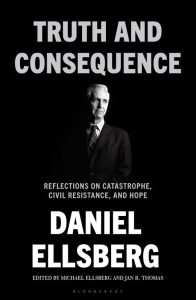
Truth and Consequence collects a number of Ellsberg’s personal essays, selections from his notebooks, and essays about terrorism and nuclear catastrophe. Ellsberg was preoccupied with power, bargaining, coercion, and risk, as well as decision-making under uncertainty; he sought to understand what motivated people in power, and why so many found it easier to go along with policies and decisions they found unlawful or inhumane rather than objecting. Spanning a half century, the notebooks contain variations on these matters, often consisting of a single sentence or paragraph, a question for future rumination. Most people, Ellsberg noted, conform and accept; a tiny minority resist, take risks, and accept the consequences, which might include forfeiture of position, privilege or belonging. The notebook entries are a fascinating window into Ellsberg’s thought process, revealing an individual grappling with existential questions and complex systems.
This collection also provides insight into Ellsberg’s early life, including his efforts to satisfy his mother’s dream that he become a concert pianist. From an early age, Ellsberg’s life revolved around piano lessons, practice, and recitals; while his peers were outside riding bicycles or playing sports, Ellsberg was practicing, hour upon hour. What neither Ellsberg or his mother knew was that he was practicing in a manner that would never lead to the concert stage. When a new teacher made this clear, Ellsberg, then nearing his teens, was both relieved and terrified; on one hand he was free, but on the other he feared losing his mother’s love. Not long after, on a family trip to Colorado, Ellsberg’s mother and sister were killed when their car veered off the road and struck a wall; Ellsberg’s father had briefly fallen asleep at the wheel. Daniel was in the back seat and suffered a concussion, a deep cut on his forehead, and a broken right leg. Because his mother and father were devout Christian Scientists, Daniel’s father initially refused medical attention. If not for the timely intervention of his brother Harry, Daniel’s right leg would have been permanently an inch and a half shorter than his left.
For many years thereafter, Ellsberg struggled with guilt. Why did he survive and his sister and mother die? Why did he experience an inability to mourn their deaths? It took years to reconcile these feelings. An inveterate procrastinator, Ellsberg often missed deadlines, meetings and flights, and he traced this habit back to the piano: practice was one thing, performing another. Making notes, posing questions and reflecting on his reading was safe, while publication was uncertain.
In the Foreword, Robert Ellsberg notes that his father was a complicated man, with an acute appreciation for beauty, music, poetry and flowers, and at the same time preoccupied with the darkest moments in history, and the darker moments to come. He spent much of his life thinking about nuclear or environmental catastrophe, not because he found these subjects fascinating, but because he wished to make them unthinkable. “We are a very flawed species, dangerously so,” Ellsberg wrote. “We are dangerous to ourselves in the short and long run and we are the enemy that threatens the long-run survival of most other species.”
I found dozens of thoughts in Truth and Consequence that speak to our political moment. In many aspects Ellsberg was prophetic. He referred to himself as a Loyal Mutineer who had an obligation to expose secret, corrupt, or unconstitutional practices and abuses of power. In 2003, Ellsberg noted: “Among the emergencies we face are the ecological crisis, creeping fascism (not creeping…galloping!), and the 500-year crisis of white supremacy.” Prophetic indeed.
Daniel Ellsberg possessed the kind of moral clarity and courage that seems almost entirely absent among today’s political, corporate, and social elites; when the right thing to do carries little to no chance of reward, and a big chance of loss or punishment, far too many retreat into comfortable silence and profitable acquiescence.